
Traffic & Growth for a Printable Business (No Hype, Just the System)
One simple, platform-agnostic system to get steady traffic, capture it, and turn it into sales – one repeatable step at a time
Most printable business advice online sounds like it came from someone trying to sell a shortcut instead of building a business.
Traffic and growth for a printable business gets way easier when you stop chasing hacks and build one connected system.
“Post 50 pins a day.” “Go viral on Instagram.” “Make passive income while you sleep.” “Just upload to Etsy and wait.”
That’s not a system. That’s noise.
A real printable business grows from repeatable actions that stack over time. Not overnight spikes. Not random trends. Not trying to be everywhere at once.
If you’re building this as a solo creator (while working a job, managing life, or figuring things out in public), you don’t need a complicated marketing machine.
You need one thing: a simple traffic system that consistently brings the right people to one clear destination.
Not ten funnels. Not seventeen platforms. Just consistent traffic flowing toward one offer, one signup point, or one next step.
This post breaks down the system behind that idea—the one that connects content, Pinterest, social media, and email into a single engine that gets stronger every month instead of burning you out after two weeks.
Quick version (so you don’t overthink it)
Build one connected engine: create useful content, distribute it consistently (Pinterest + social), and capture the traffic (email list or community). Pick one main CTA and point everything to it. Track a few simple numbers weekly, then improve what’s already working instead of constantly starting over.
That’s the core of traffic and growth for a printable business: connect your efforts so it compounds.
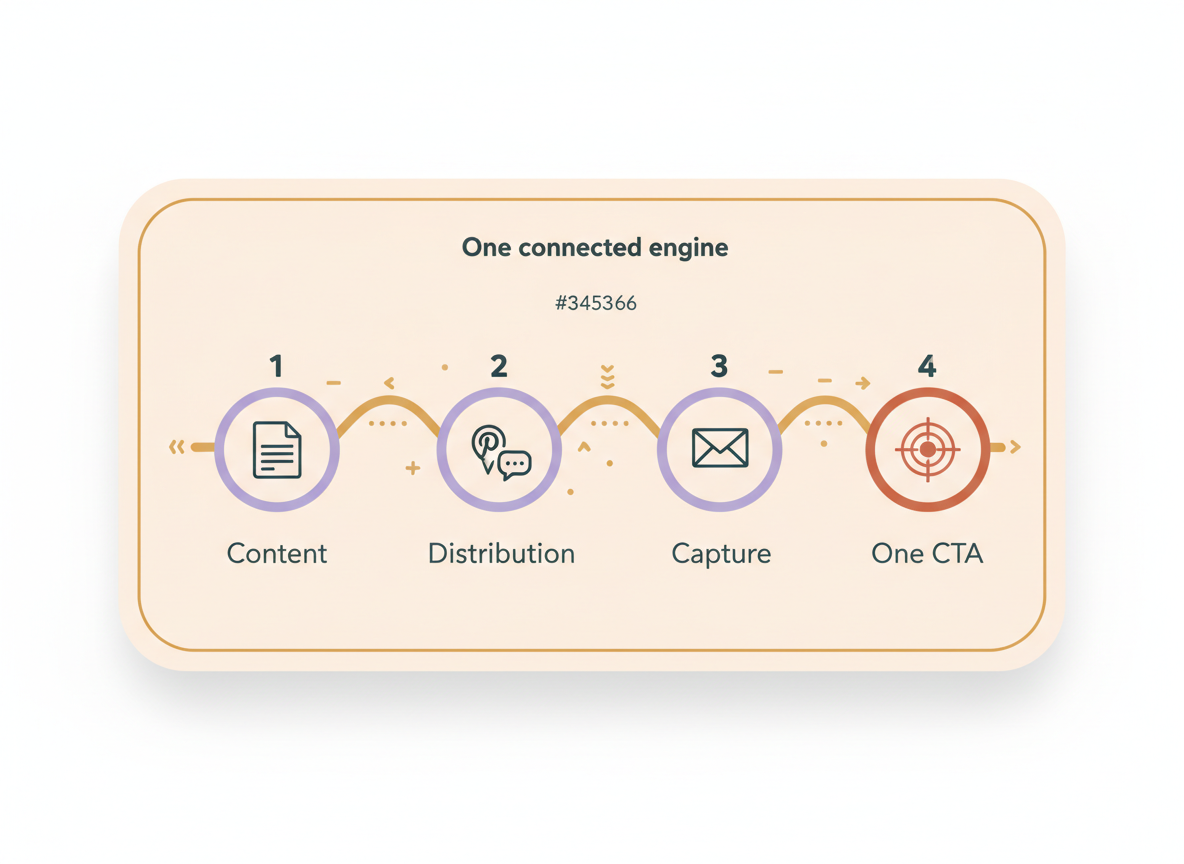
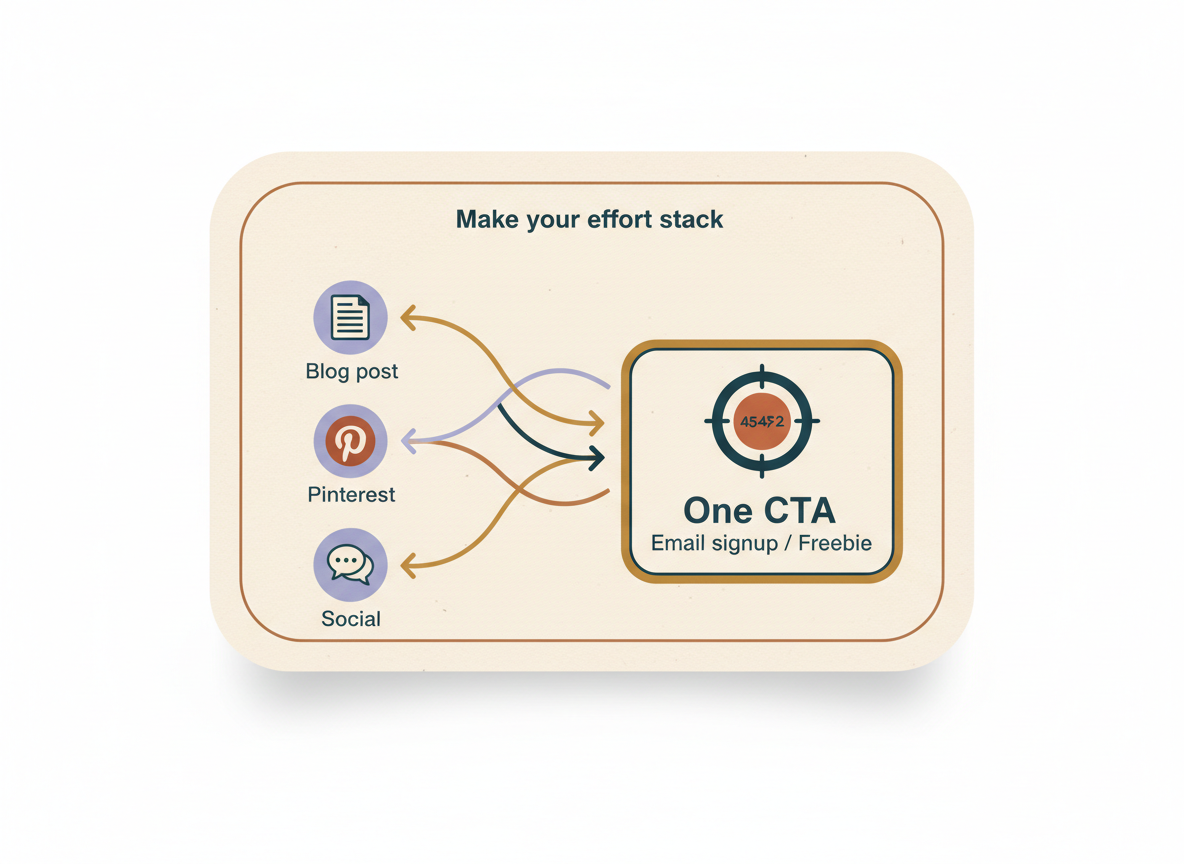
The Only Goal at First: Consistent Traffic to One CTA
Most beginners split their attention too early.
If you’re working on traffic and growth for a printable business, this is the simplest target that keeps you from scattering.
One day it’s Pinterest. The next day it’s redesigning an Etsy banner. Then it’s chasing TikTok trends. Then it’s rewriting a logo. Meanwhile, nothing is connected.
Early on, the goal isn’t “build a brand empire.” The goal is simpler: get consistent traffic to one CTA.
That CTA can be a lot of things:
- Weekly Build Drops
- A free printable vault
- A starter pack
- Regular new product releases
- Behind-the-scenes creator updates
The exact offer matters less than the consistency. You’re training people to associate your content with one predictable destination.
Once you do that, your content stops acting like random one-off posts and starts acting like a system:
Content creates curiosity. Curiosity earns clicks. Clicks turn into signups. Signups build an audience. And that audience compounds.
That’s why random posting feels exhausting. Without a central CTA, every piece of content starts from zero.
But when everything points to one destination, even small traffic numbers start stacking. Old blog posts can keep working. Pins can keep circulating. Emails can get forwarded. Resource pages can continue bringing people into your site. The system keeps moving even when you’re not actively posting that day.
That’s the difference.
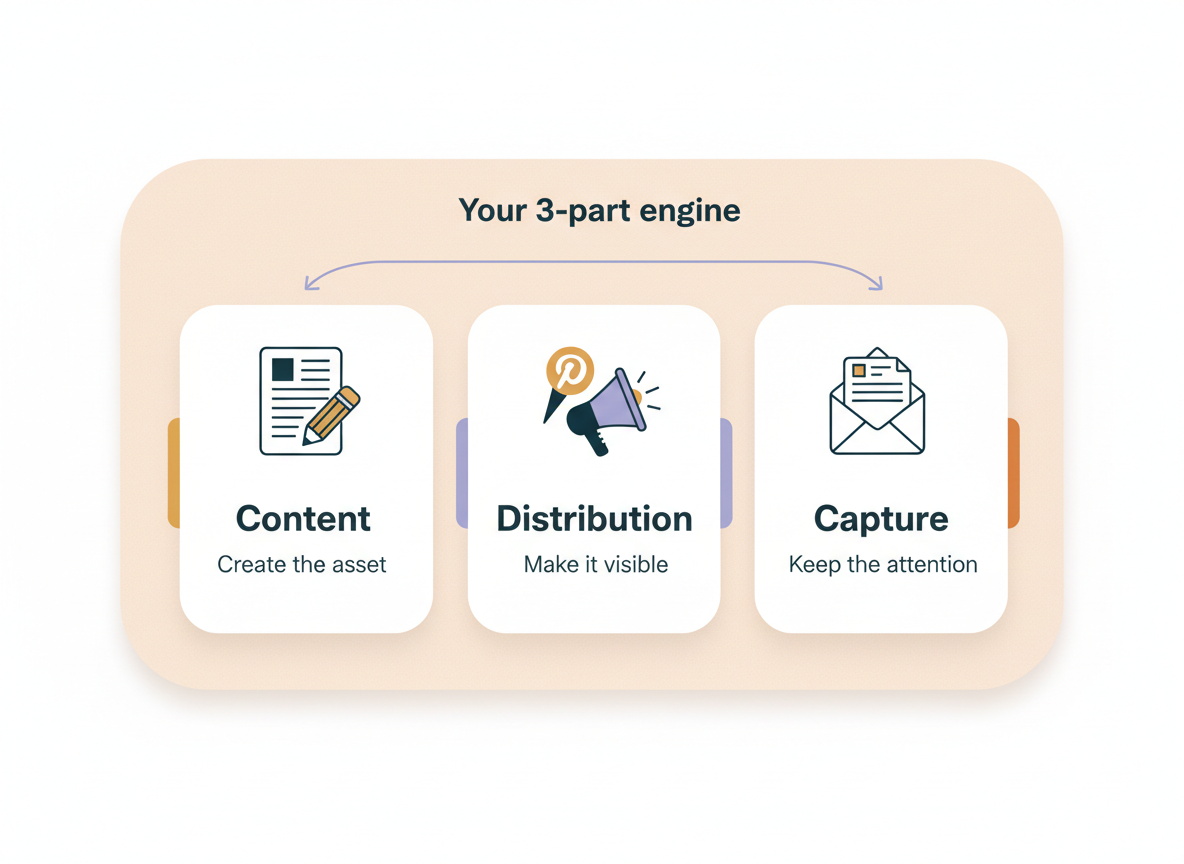
Your 3-Part Engine: Content → Distribution → Capture
Most printable creators treat marketing like separate jobs. SEO feels separate from Pinterest. Pinterest feels separate from social. Social feels separate from email.
Growth gets easier when you stop treating these like isolated tasks and start treating them like one engine.
Part 1: Content (the asset)
Content is the foundation layer. It’s the thing you create once, then reuse over and over.
That can look like blog posts, tutorials, roundups, freebies, product previews, coloring tips, “how to print at home” guides, or behind-the-scenes build logs.
The reason blog content matters is simple: search-focused content has the potential to compound. Social posts often have a shorter active lifespan, while a useful blog post can continue attracting visitors for months – or even years – when it matches real search intent.
Think about the kinds of problems people actually type into Google:
- Best paper for coloring pages
- How to print printables without blurry lines
- How to organize digital downloads
- Free activity printables for kids
- Cute printable coloring pages for adults
Those searches reflect real needs and interests. When your content genuinely satisfies that search intent, you give it a better chance of earning relevant traffic.
Part 2: Distribution (make it visible)
Creating useful content is only half the job. You also need to give people practical ways to discover it.
This is where Pinterest and social media fit—and for printables, Pinterest is especially strong because printables are visual. They naturally connect to inspiration, creativity, organization, hobbies, and self-improvement.
The biggest mistake creators make is treating Pinterest like a full-time job. It doesn’t need to be.
For each blog post, a simple workflow is enough. Create a few pin variations, test different headlines and layouts, and link each one back to the relevant article. Then schedule them consistently.
Not 100 pins a day. Consistency beats intensity.
Social works the same way. Instagram and Facebook should amplify what you already made, not create endless new work.
One blog post can turn into a carousel, a short caption, a “mistake creators make” post, a behind-the-scenes image, a quick tip graphic, or a printable preview.
You’re not creating from scratch every day—you’re repurposing intelligently. That distinction matters, because burnout kills consistency.
Part 3: Capture (keep the attention)
Traffic without capture is borrowed attention.
If someone visits once and you have no way to reconnect with them, you may have to earn their attention all over again. That’s why email matters.
Your email list gives casual visitors a way to become repeat readers, customers, and supporters over time. For a printable business, that gives you a direct way to share useful resources, updates, and new releases with people who chose to hear from you.
You don’t need daily emails or a complicated newsletter. A simple weekly email can be a practical place to start.
You can send new releases, weekly build updates, your top post of the week, free download links, behind-the-scenes experiments, what worked and what failed, seasonal recommendations, or a new bundle launch.
People connect with consistency more than perfection—especially in a build-in-public brand.
SEO Basics That Actually Matter for Printables
SEO gets overcomplicated fast. Most creators think SEO means chasing algorithms or stuffing keywords everywhere.
It doesn’t.
Good SEO is mostly about matching search intent clearly and consistently. Good SEO starts with understanding what people are searching for, creating genuinely useful content that satisfies that intent, and making that content easy for both visitors and search engines to understand.
1) Pick topics people are already searching for
Printable SEO topics usually fall into a few buckets: tutorials, inspiration, product discovery, organization, problem-solving, seasonal searches, and beginner help.
The clearer you are about what the searcher wants to accomplish, the easier it becomes to create content that actually serves that intent.
2) Internal linking (every page should lead somewhere useful)
Every blog post should naturally point readers to another helpful page. This keeps people on your site longer and helps search engines understand your structure.
If you write about printable storage, for example, you might link to a related checklist, a relevant printing guide, or another resource that genuinely helps the reader take the next step.
3) Update old posts
Old content isn’t dead content. Sometimes the fastest growth comes from improving what already exists.
Better images, stronger titles, relevant internal links, updated Pinterest graphics, clearer formatting, stronger CTAs, and better examples can give existing content a much stronger chance to perform.
4) Intent over keywords
Keywords matter, but intent matters more.
Someone searching “how to print coloring pages without black streaks” wants a fix. Someone searching “cute printable coloring pages for adults” wants inspiration or products.
Match your content to the reason behind the search, and you give it a better chance of satisfying both the reader and the search intent.
Pinterest for Printables (Simple Workflow)
You don’t need to make Pinterest unnecessarily complicated. What matters is building a repeatable publishing workflow you can realistically maintain.
Publish one useful blog post. Then create multiple Pin variations that lead back to it, testing different headlines, images, or layouts to give people different ways to discover the same useful content.
Same article. Different entry points.
Templates make this sustainable. With templates, you can swap titles, images, colors, and previews quickly without reinventing the wheel.
Unlike a short-lived promotional post, a useful Pin can continue giving people another way to discover your content well after you publish it. That long-term discovery potential is one reason Pinterest can fit a printable-content strategy.
Social Media as Amplification (Not Your Main Job)
Social media can help, but it shouldn’t consume your entire workflow.
A lot of creators spend hours producing short-lived social content while neglecting longer-term assets such as useful blog posts, Pinterest content, email lists, and searchable resources.
Instead, social should amplify your core content, not replace it.
A useful blog post can give you material for multiple social posts: a quick tip, a key takeaway, a behind-the-scenes observation, a visual example, or a question that points people back to the original content.
A build-in-public approach also gives you useful material to share without manufacturing something new every day. Progress, decisions, experiments, mistakes, and lessons can all become part of the story. You don’t need to present yourself like a giant polished company; showing the real process can give people a clearer reason to follow along.
Email List Growth (The “Why” + What to Send Weekly)
Building an email list gives you a more direct way to stay connected with people who have chosen to hear from you. Even a small list can matter because you’re not relying entirely on someone finding you again through search or social media.
Platforms change. Search traffic fluctuates. Social reach can rise or fall. An email list gives you another way to reach people who have already asked to stay connected, which makes it a useful part of a more resilient traffic system.
You also don’t need to cram everything into every email. A simple update can pull from things like:
- One new blog post
- One new printable release (or a featured product)
- One behind-the-scenes lesson
- One quick creator update
- One featured freebie or resource
Pick what is actually worth sharing that week and give the reader one clear next step. That’s the approach behind my Weekly Build Drops, where I share what I’m building, what I’m learning and useful resources as the business develops.
What to Track on Your Live Scoreboard
Most creators track feelings instead of data, and that gets confusing fast.
Your Live Scoreboard doesn’t need to be fancy. A simple spreadsheet works.
Track:
- Traffic (blog visitors, Pinterest clicks, social traffic, search traffic)
- Clicks (how many people click your CTA)
- Signups (how many join your email list)
- Conversion rate (what percentage of the relevant visitors or clicks complete the action you’re measuring)
- Assets published (how many useful pieces of content, Pins, resources, or other assets you actually shipped)
That last number is easy to overlook, but it matters. Tracking what you actually publish helps separate productive activity from all the planning, tweaking, and busywork that can feel productive without putting anything new into the world.
30-Day “Publish → Learn → Improve” Plan
For your first 30 days, focus on building momentum and learning from what you publish rather than trying to perfect the entire system at once.
Week 1: Publish one useful foundational piece of content, create supporting Pins, add a clear email CTA, and share the content through the social channels you actually use.
Week 2: Publish or improve another useful piece of content, strengthen relevant internal links, send an email update, and make sure your traffic is pointing toward one clear step.
Week 3: Create additional distribution assets for the content you already have, review early clicks and signups, and look for obvious friction in your CTA or visitor path without overreacting to limited data.
Week 4: Review your scoreboard, identify what produced useful signals, decide what deserves another month of effort, and remove work that is adding complexity without supporting the system.
The goal isn’t explosive growth in 30 days. The goal is building a system you can realistically maintain for the next 12 months.
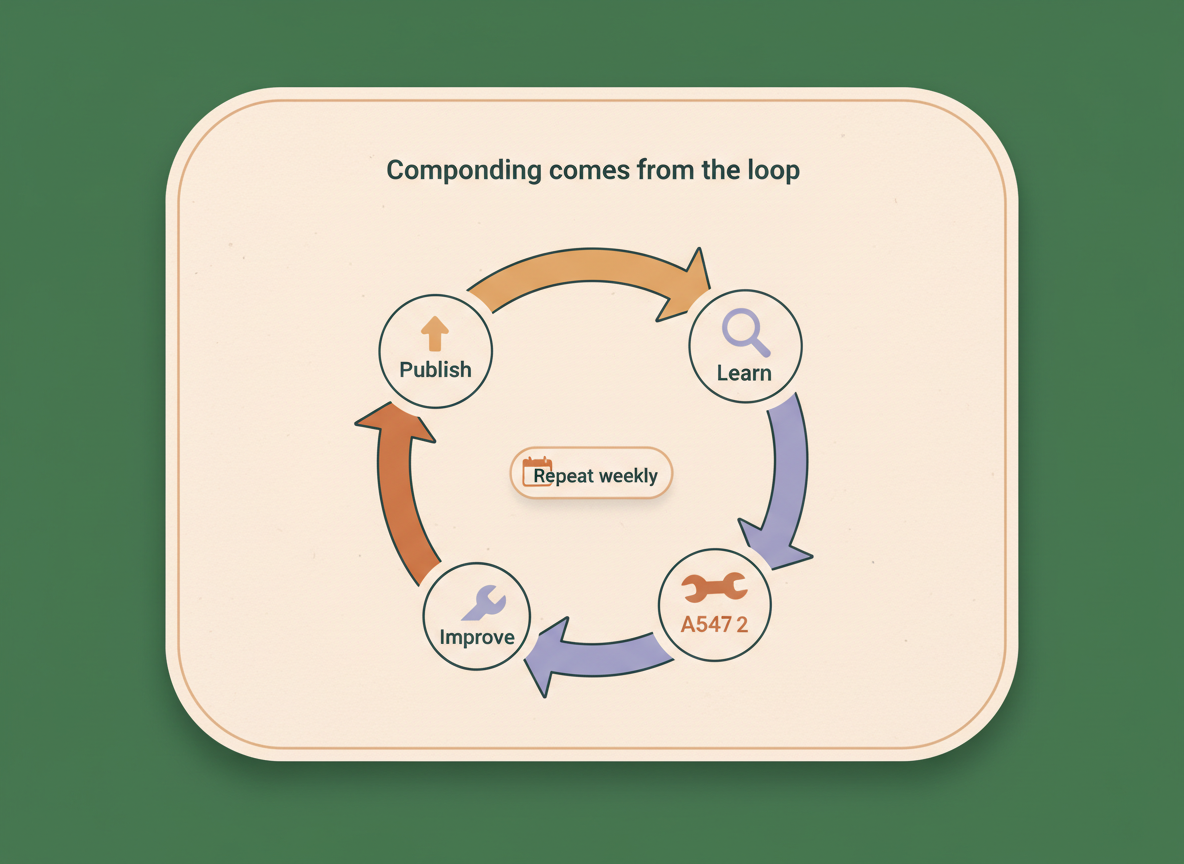
Because traffic systems are rarely built through one viral moment. They’re built through repeated cycles of:
Publish. Learn. Improve. Repeat.
It may sound less exciting than an overnight-success story, but a repeatable system gives you something far more useful: a process you can measure, learn from and improve.
Conclusion: Build the engine, not the hype
If you take nothing else from this post, take this: growth gets easier when your efforts connect.
Create one useful piece of content. Distribute it consistently. Capture the traffic. Track a few numbers. Improve what’s already working.
That’s the basic growth loop. Not because it’s flashy, but because it gives you a repeatable process you can actually evaluate and improve.
One useful piece of content. Supporting distribution. A simple email. One clear next step. Then learn from what happened and run the loop again.
Your next 30 minutes (simple, measurable)
If you want a quick win today, don’t brainstorm a new platform. Do one small thing that makes your system more connected:
- Add or improve the CTA one important existing post
- Create another useful Pinterest entry point for content you’ve already published
- Add a relevant internal link between two genuinely related pages
- Write one useful email that gives readers a clear next step
Small improvements like these may not feel dramatic, but they make the pieces of your traffic system more connected and give the work you’ve already done more opportunities to be useful.
FAQ: Traffic & growth for printable businesses
Want to See a Finished Printable Product in Action?
If you’re building your own printable products, you can download the free Kawaii Mega-Sampler to see a real Color Me Crazy Club printable product, experience the customer side of the download process, and get a few coloring pages to enjoy along the way.