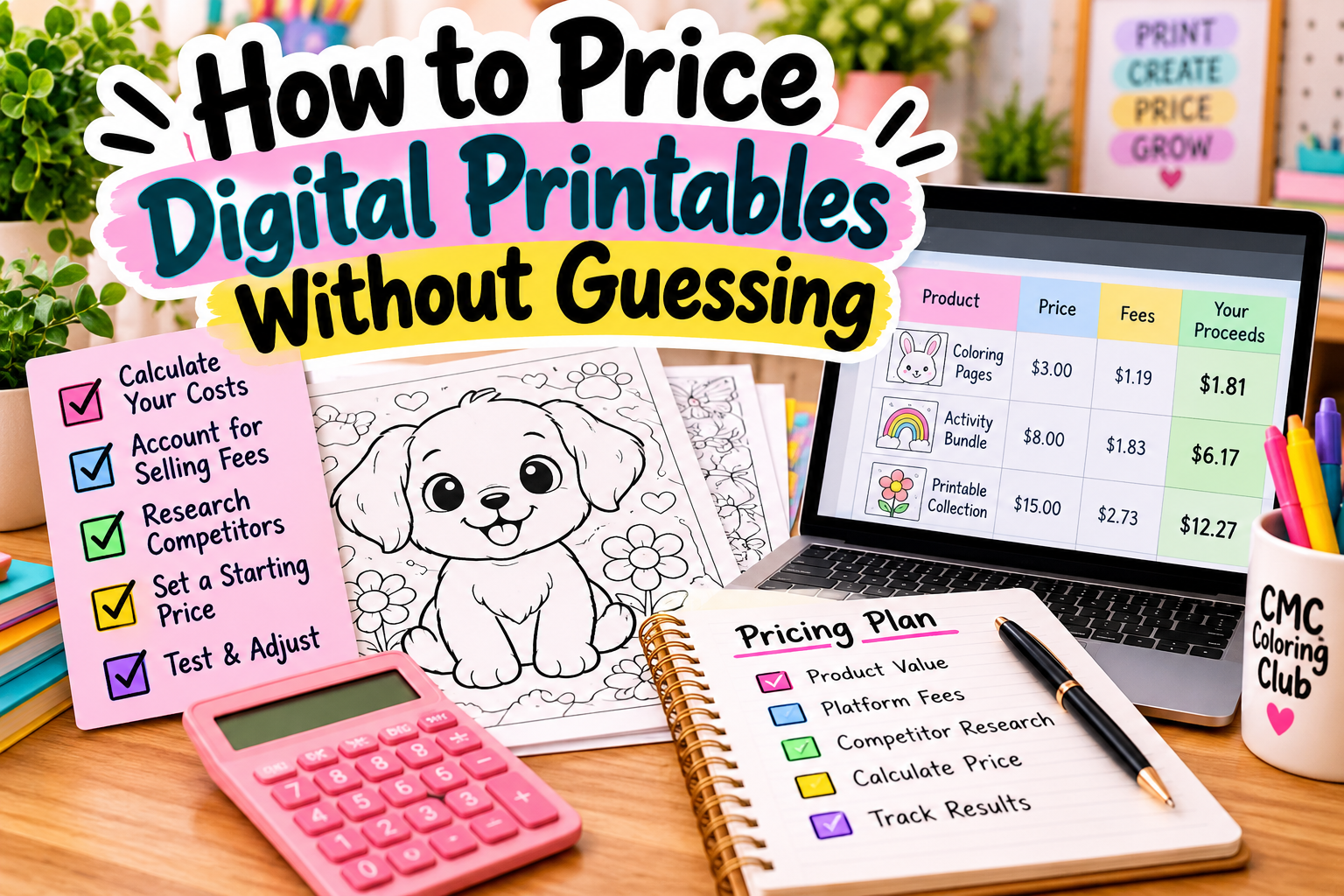
How to Price Digital Printables Without Guessing
Learn how to calculate costs, account for selling fees, and set profitable starting prices for your digital printables.
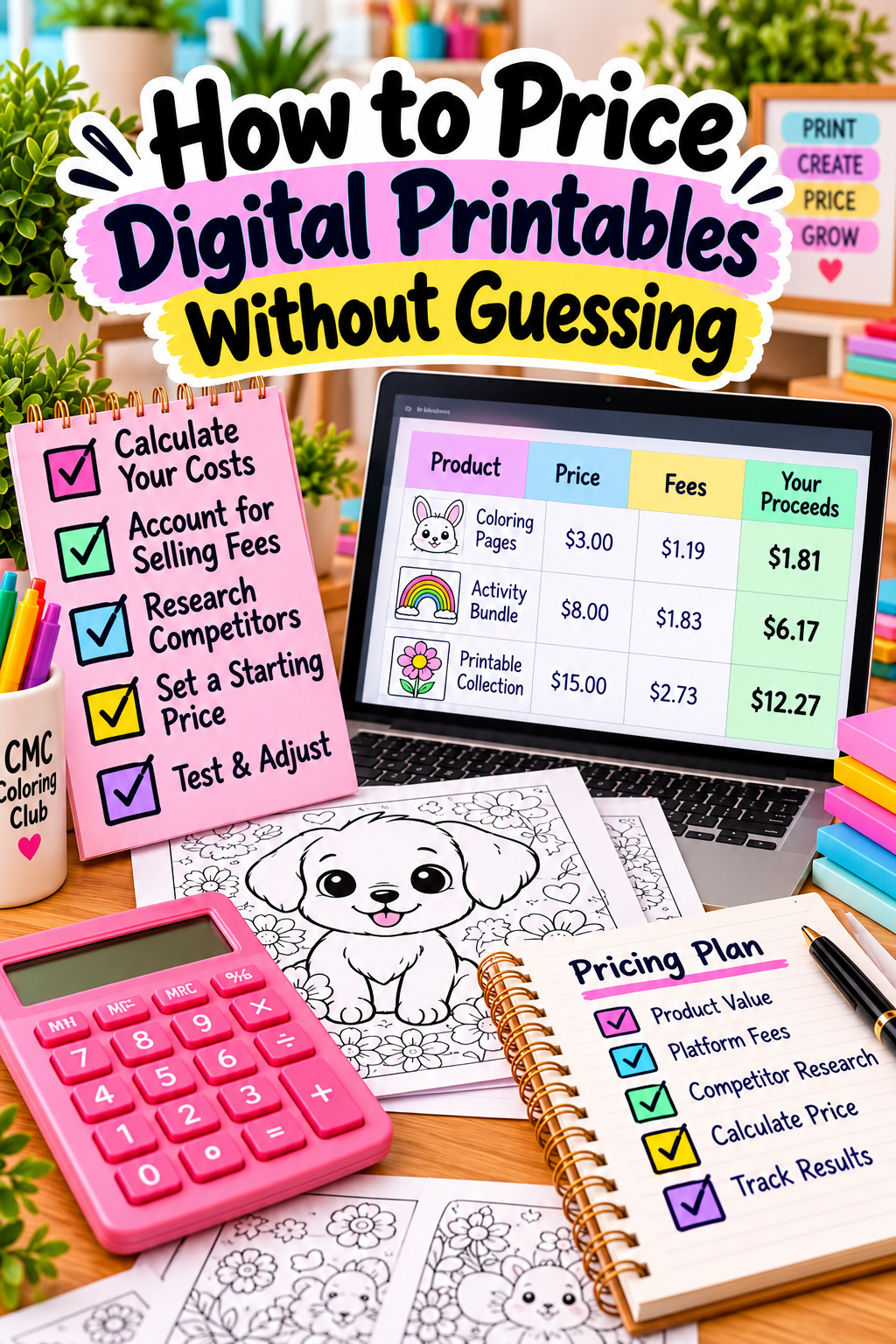
You finished your printable product. The pages look good, the PDF works, and you’re ready to publish.
Then you reach the pricing field.
Should you charge $3, $7, or $12?
You look at similar products online. One seller charges $2. Another charges $15. Both seem to offer something comparable.
Now you’re more confused than when you started.
Here’s what many new printable creators overlook: the price your customer pays isn’t the amount you keep, and the price your competitor charges doesn’t tell you whether their business is profitable.
You need a better way to make the decision.
This guide will help you calculate your costs, understand selling fees, compare competing products, and choose a starting price you can test with real customers.
You won’t find a magic price that guarantees sales. You’ll learn how to make a pricing decision based on evidence instead of guesswork.
The Smart Way to Price Your Digital Printables
Pricing digital printables doesn’t have to be a guessing game. Start by calculating your production costs, including design time, software, and testing. Next, account for platform fees so you know how much money you’ll actually keep from each sale. Research similar products to understand what customers are paying, but don’t copy competitor prices without comparing value. Finally, choose a reasonable starting price, track your results, and adjust based on actual sales data. The goal isn’t to find the cheapest price. It’s to find a price that makes sense for your customers and supports a sustainable printable business.
Why Pricing Digital Printables is Different
Digital printables have an unusual advantage.
You create the original product once, then potentially sell copies without manufacturing a new physical item for every customer.
If you’re still learning how to create your first product, start with our Printable Product Creation Guide to understand the process from idea to finished download.
But that doesn’t mean your product costs nothing to produce or sell.
Consider a printable coloring book.
You might spend several hours developing illustrations, formatting pages, checking margins, creating product previews, and testing the finished PDF.
Those hours have value.
You may also pay for design software, commercial-use assets, or other production tools.
Then, when a customer buys your product, your selling platform may deduct transaction fees.
Your pricing strategy needs to account for these expenses while still offering something customers consider worth buying.
The first step is understanding what you’re actually selling.
Understand the Value of Your Printable
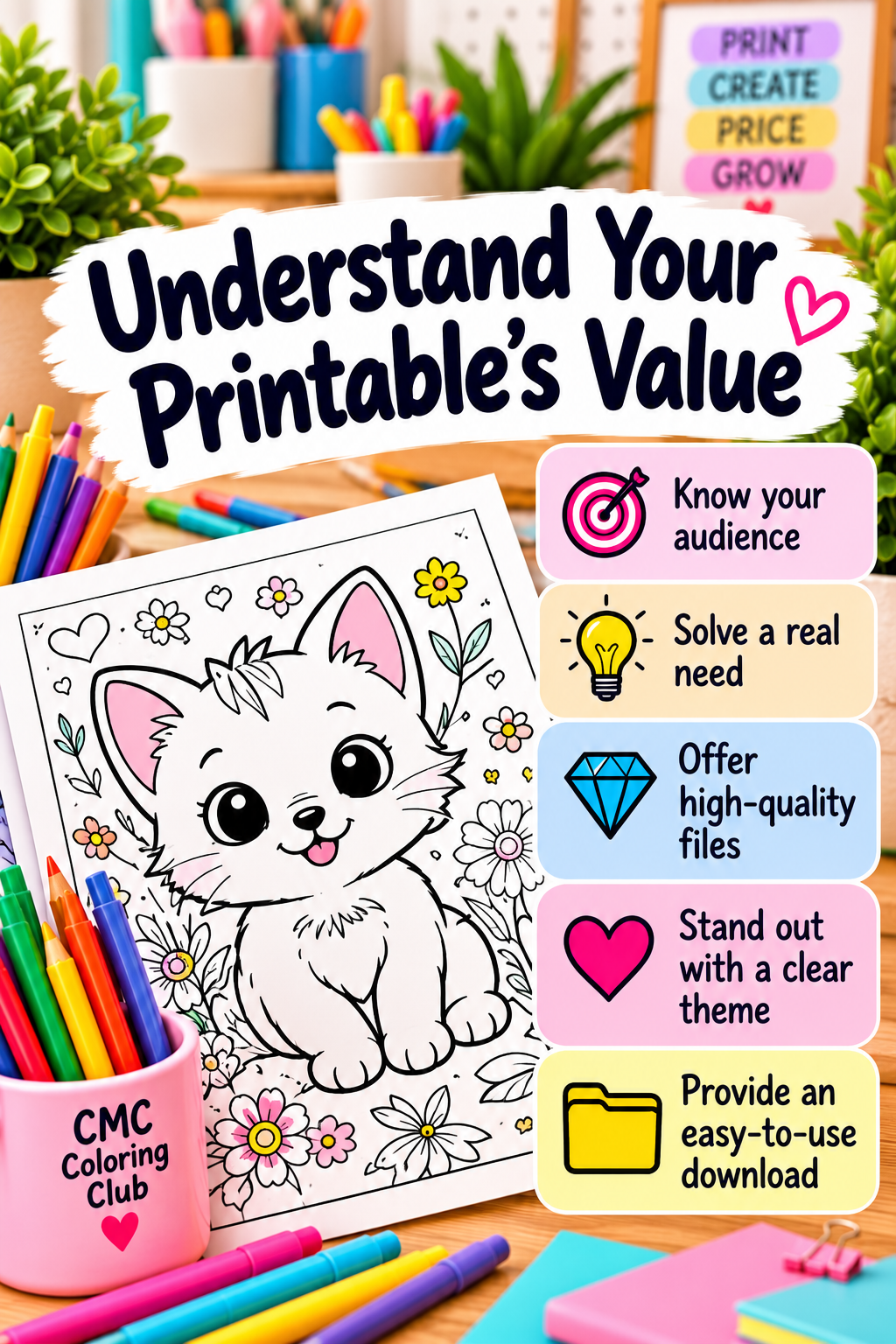
Imagine two printable coloring products.
Product A contains 30 loosely related coloring pages with inconsistent formatting.
Product B contains 20 carefully designed pages built around a specific theme, with consistent margins, clear printing instructions, and an organized download.
Which product offers more value?
The answer isn’t automatically the one with more pages.
Customers may value convenience, consistency, usefulness, and how well a product fits their needs.
A parent looking for a rainy-day activity may appreciate a themed activity pack that requires little preparation.
A teacher may prefer worksheets organized around a particular skill.
An adult coloring enthusiast may value a distinctive illustration style.
Before setting your price, answer four questions:
- Who is this product for?
- What does the customer receive?
- What problem does it solve or experience does it provide?
- Why would someone choose it over a similar product?
These answers help you explain the value of your printable without relying entirely on page count.
Licensing also matters. A personal-use printable and a product that explicitly grants commercial rights are not equivalent offers. Never imply that a printable includes resale or commercial rights unless its specific license allow s them.
Calculate What Your Printable Actually Costs
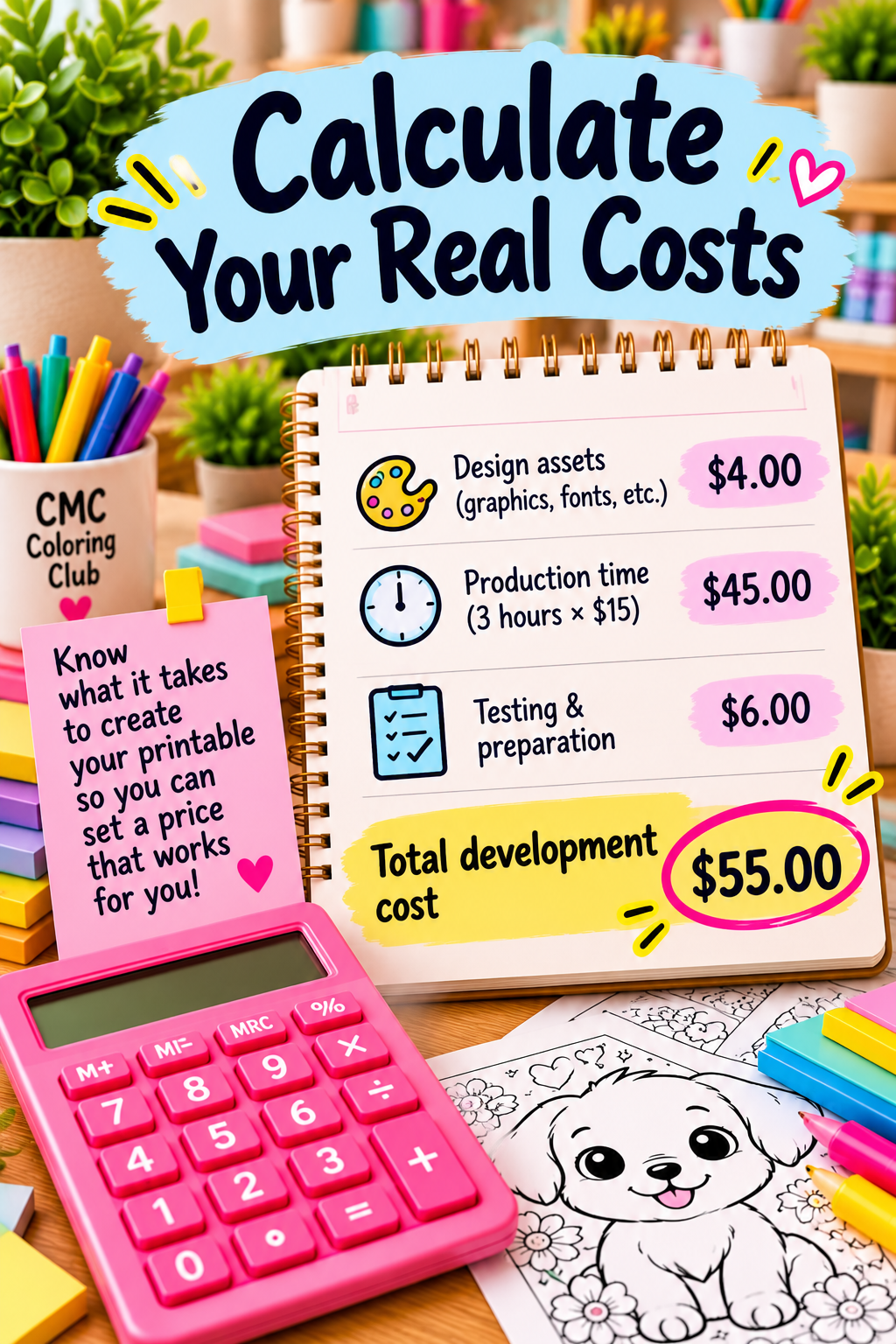
One common pricing mistake is ignoring the work required to create the product.
Start by identifying your development expenses.
For example, suppose you create a themed printable activity bundle.
|
Development expense |
Example Cost |
|---|---|
|
Design assets allocated to the product |
$4 |
|
Three hours of production time at $15 / hour |
$45 |
|
Testing and preparation |
$6 |
|
Total development cost |
$55 |
These figures are hypothetical.
Your actual costs might be lower or higher, especially if you use tools you already own or create illustrations yourself.
Notice that the $55 is a development cost, not necessarily a cost incurred every time you make a sale.
That’s an important distinction.
If you sell one copy, the entire development cost hasn’t necessarily been recovered.
If you sell 20 copies, that same development cost can be spread across more transactions.
However, you still need to account for expenses that occur with each sale, such as platform fees, and any continuing expenses such as advertising or customer support.
Should You Pay Yourself for Design Time?
Yes, at least in your planning calculations.
Even if you don’t transfer money to yourself for every hour worked, tracking your time helps you understand whether a product is worth repeating.
Suppose one product takes two hours to create and another takes 15 hours.
If both generate the same proceeds, they don’t offer the same return on your time.
Tracking production hours can help you improve your workflow and decide which product types deserve more attention.
Understand Gumroad Fees Before Choosing a Price
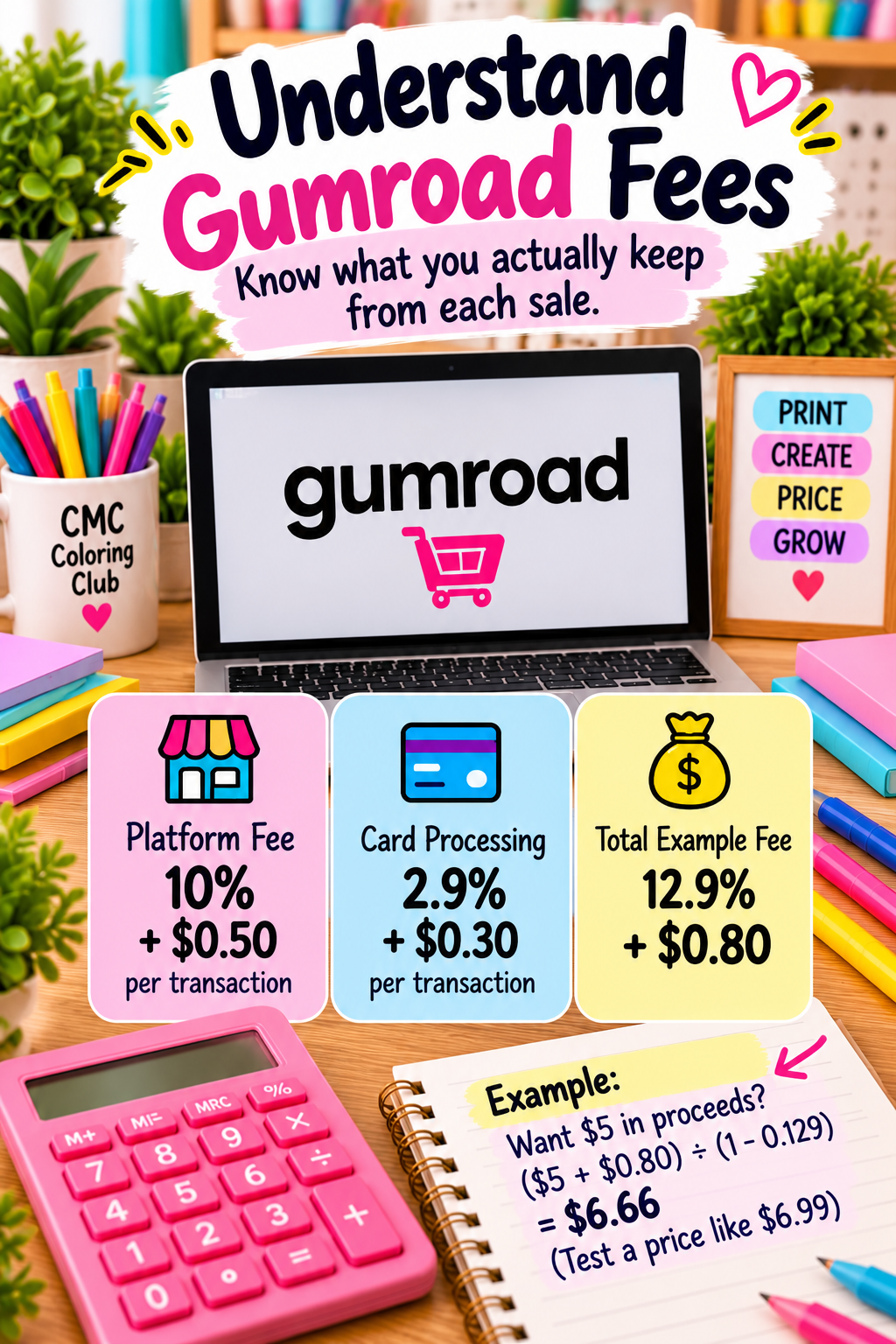
If you’re selling through Gumroad, you need to understand how it fees affect the money you keep.
According to Gumroad’s published fee documentation, standard direct sales are subject to a platform fee of 10% plus $0.50 per transaction. Credit card processing is listed separately at 2.9% plus $0.30.
For a typical direct card sale under those assumptions, that means:
- 12.9% of the selling price.
- An additional $0.80 in combined fixed fees.
Gumroad also lists a 30% flat fee, including processing, for sales generated through its Discover marketplace.
Other payment methods, applicable taxes, account-specific arrangements, refunds, and additional charges can affect actual proceeds. Gumroad’s fee structure may also change, so verify it before making pricing decisions.
Official reference: https://gumroad.com/help/article/66-gumroads-fees
What Happens to a $3 Printable?
Let’s use the standard direct-card-sale assumptions.
Selling price: $3.00.
Percentage fees: $0.387
Combined fixed fees: $0.80
Estimated proceeds:
$3.00 – $0.387 – $0.80 = $1.813
That’s approximately $1.81 before your development costs, other expenses, and income taxes.
You haven’t necessarily made $1.81 in profit.
You’ve received approximately $1.81 after the modeled transaction fees.
That distinction becomes important when you’re selling inexpensive digital products.
The Printable Pricing Formula
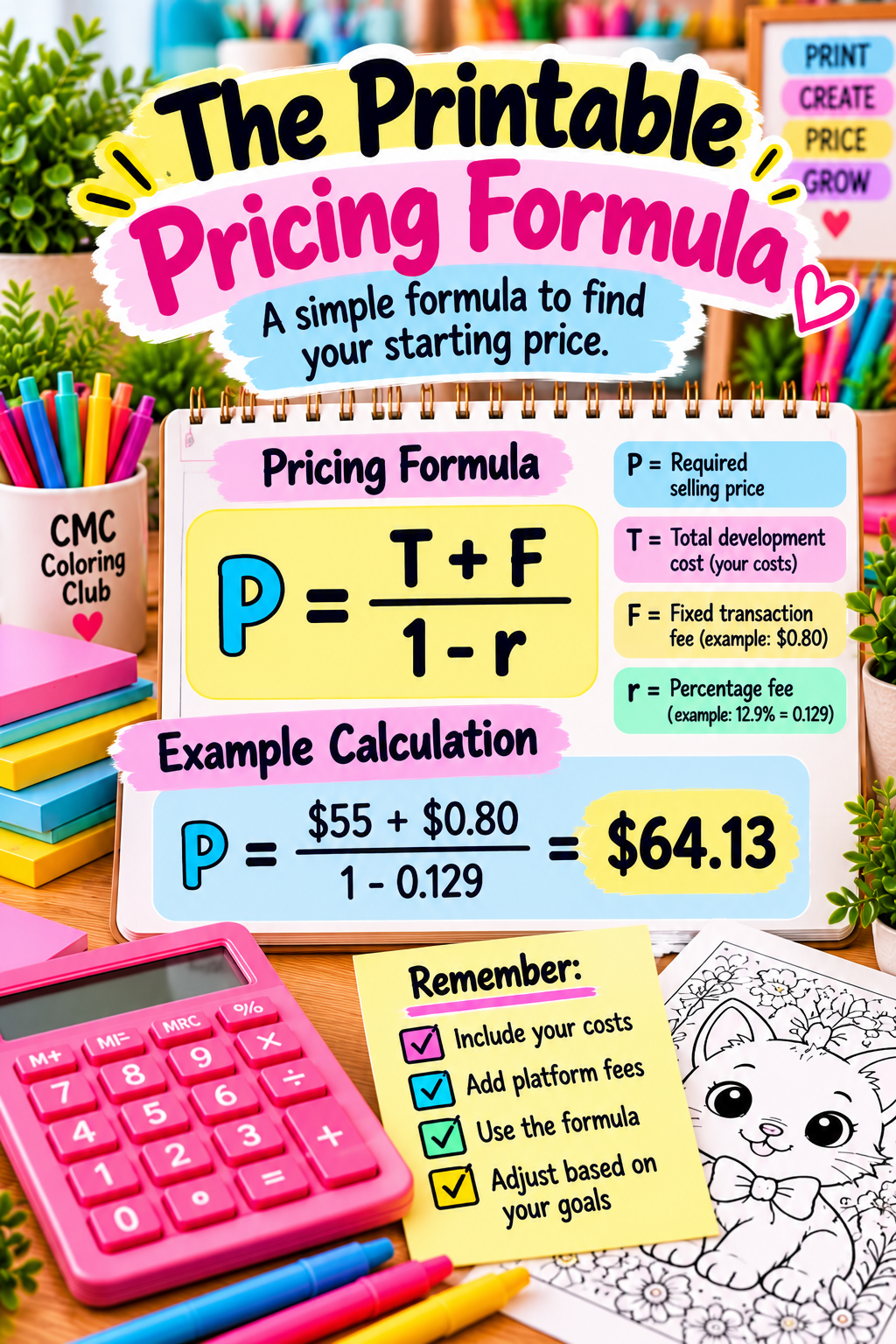
Instead of choosing a price first and hoping the numbers work, trying working backward.
Start with the amount you want to receive from each sale after the modeled transaction fees.
Use this formula:
Required price = (Desired proceeds + Fixed transaction fees) / (1 – Percentage fee rate)
For example, suppose you want approximately $5 in proceeds from a standard direct card sale.
Using the fee assumptions above:
Required price = ($5 + $0.80) / (1 – 0.129)
Required price = ($5.80) / (0.871)
Required price = $6.66
You could test a price such as $6.99, then calculate the expected proceeds.
At $6.99:
$6.99 – ($6.99 x 0.129) – $0.80 = $5.29
This gives you a starting point based on your desired proceeds.
It doesn’t prove customers will pay $6.99.
That’s where market research and testing come in.
A Simple Pricing Worksheet
Before publishing, record:
|
Question |
Your answer |
|---|---|
|
Product type |
_________________________ |
|
Intended customer |
_________________________ |
|
Development cost |
$________________________ |
|
Desired proceeds per sale |
$________________________ |
|
Expected selling fees |
_________________________ |
|
Calculated starting price |
$________________________ |
|
Comparable product price range |
$________________________ |
|
Final test price |
$________________________ |
Keep this worksheet for every new product.
Over time, you’ll build a record of your pricing decisions instead of starting from scratch each time.
Three Printable Pricing Examples
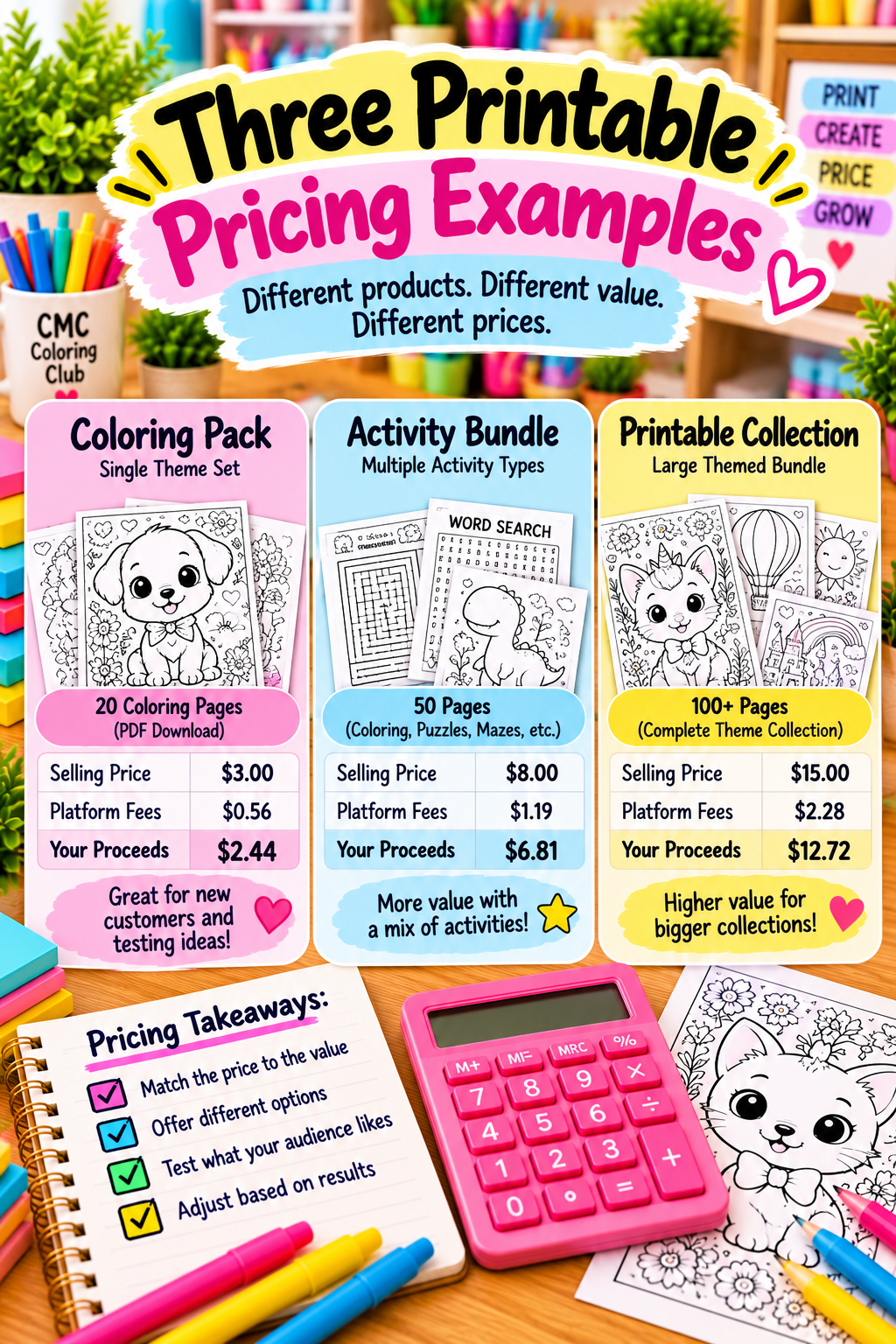
Let’s compare three hypothetical products using the same direct-card-sale fee assumptions.
|
Product |
Selling price |
Estimated proceeds after modeled fees |
|---|---|---|
|
Small coloring-page pack |
$3.00 |
$1.81 |
|
Themed activity bundle |
$8.00 |
$6.17 |
|
Larger printable collection |
$15.00 |
$12.27 |
These aren’t recommended prices or industry averages. They’re examples to demonstrate how the calculation works.
The $8 bundle produces approximately $6.17 after the modeled transaction fees.
If it cost $55 to develop, you’d need approximately nine full-price sales to recover that development cost from those proceeds, assuming no other expenses..
Nine sales would produce approximately $55.51 in total proceeds after the modeled transaction fees.
That doesn’t mean nine sales are guaranteed.
It simply gives you a measurable recovery target.
Now imagine you sell only two copies.
That result doesn’t automatically mean the price is wrong.
Perhaps very few people visited your listing. Perhaps your product previews weren’t clear. Perhaps the intended audience wasn’t reached.
Pricing is only one part of the sales process.
Research Competitors Without Copying Their Prices
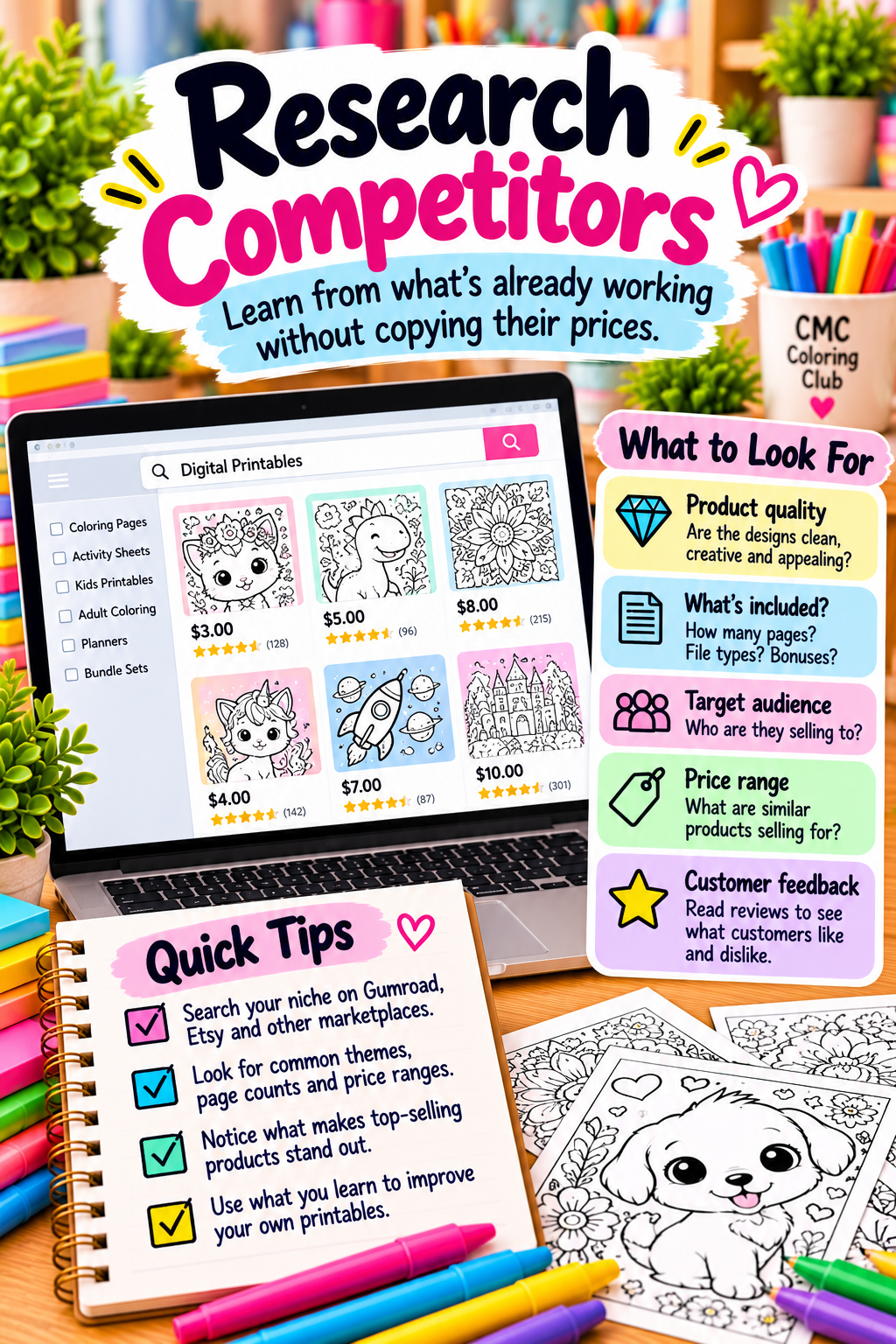
Competitor research is useful, but only when you’re comparing products fairly.
Search for printables that serve the same type of customer and solve a similar problem.
Choosing the right search terms also helps you understand how customers describe the products they want. Our SEO Keywords for Printables guide explains how to research those terms.
If you’re creating a Halloween coloring bundle for elementary-age children, compare it with similar seasonal coloring products.
Don’t use a comprehensive classroom curriculum as your only benchmark.
When researching competitors, record:
- Selling price.
- Number and type of included pages.
- Product theme and intended audience.
- File formats and printing options.
- Quality and clarity of preview images.
- Instructions or supporting materials.
- License terms, where available.
You can also examine customer feedback to identify features buyers appreciate or problems they encounter.
Look for patterns rather than copying a single seller.
The Cheapest Product Isn’t Always Your Best Competitor
Suppose you find three comparable products priced at $3, $7, and $11.
That doesn’t automatically mean you should charge $7.
The products might differ substantially in quality, completeness, licensing, or customer convenience.
Ask what your product provides and whether you can communicate that value clearly.
If your product offers little differentiation, a premium price may be difficult to justify.
If it solves a specific customer problem particularly well, you may have a stronger reason to test a higher price.
The goal is not to win a race to the bottom.
It’s to find a price that customers accept and that supports your business.
Should You Sell Individual Pages or Bundles?
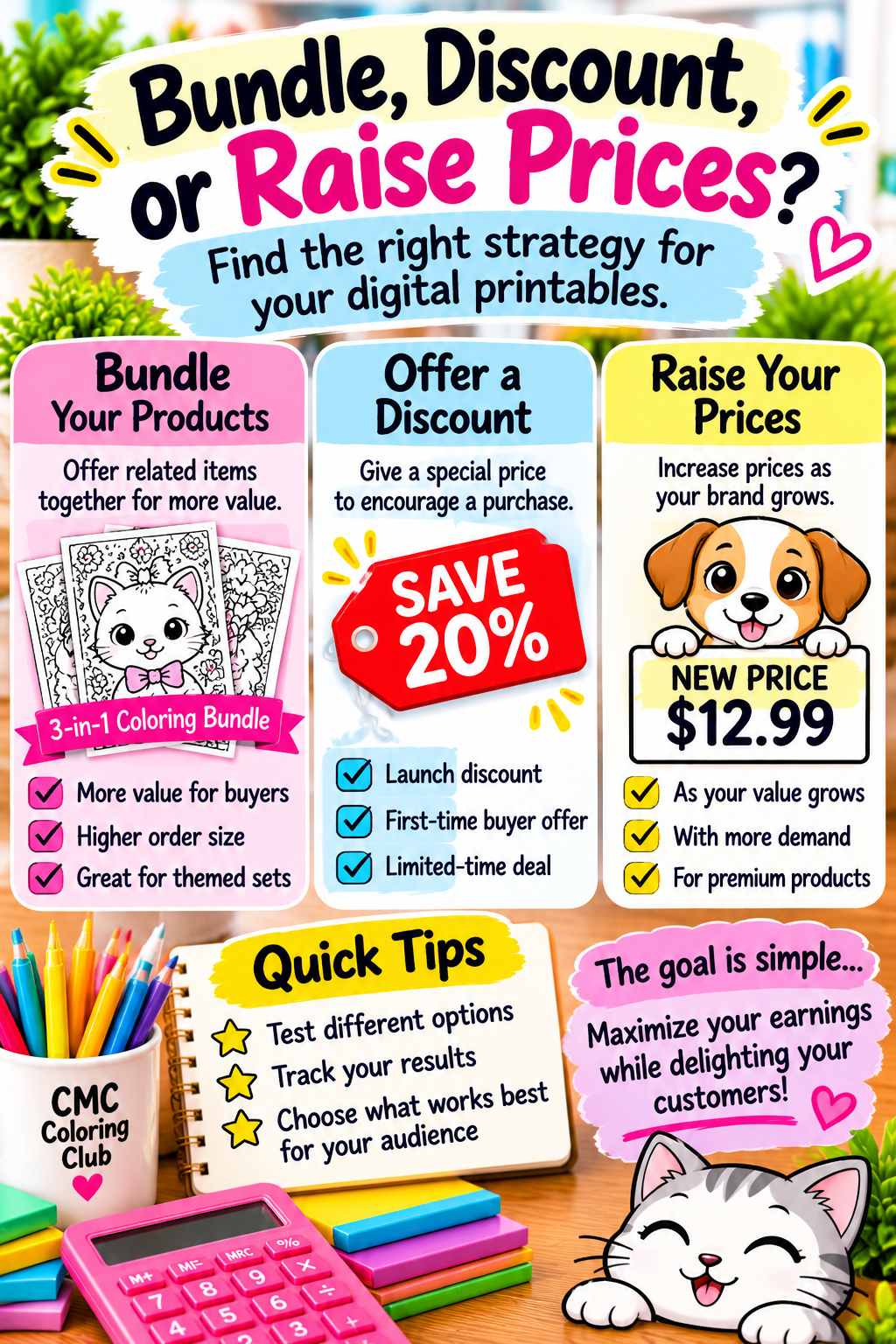
Bundling can make sense when related printables work better together.
For example, imagine you have five themed coloring packs.
You could sell each pack separately and offer a larger collection that combines them.
The bundle might provide customers with convenience and a better organized experience.
But don’t assume that putting more files into a ZIP automatically makes the product more valuable.
A useful bundle should have a clear purpose.
Ask yourself:
Does this collection help the customer accomplish something more easily?
Would the customer reasonably want these products together?
Is the bundle easy to understand and download?
Also calculate the fees for each pricing option.
Selling several low-priced products in separate transactions may create different total fees than selling them together in one transaction.
The right choice depends on your customers, product structure, and actual sales results.
What About Discounts?
Discounts can be useful for a limited promotion or a structured pricing test.
However, frequent discounting can make it harder to understand what customers are willing to pay at your regular price.
Before running a discount, calculate your expected proceeds at the discounted price.
Don’t measure a promotion only by the number of orders.
Measure what remains after fees and other expenses.
Test Your Price for 30 Days
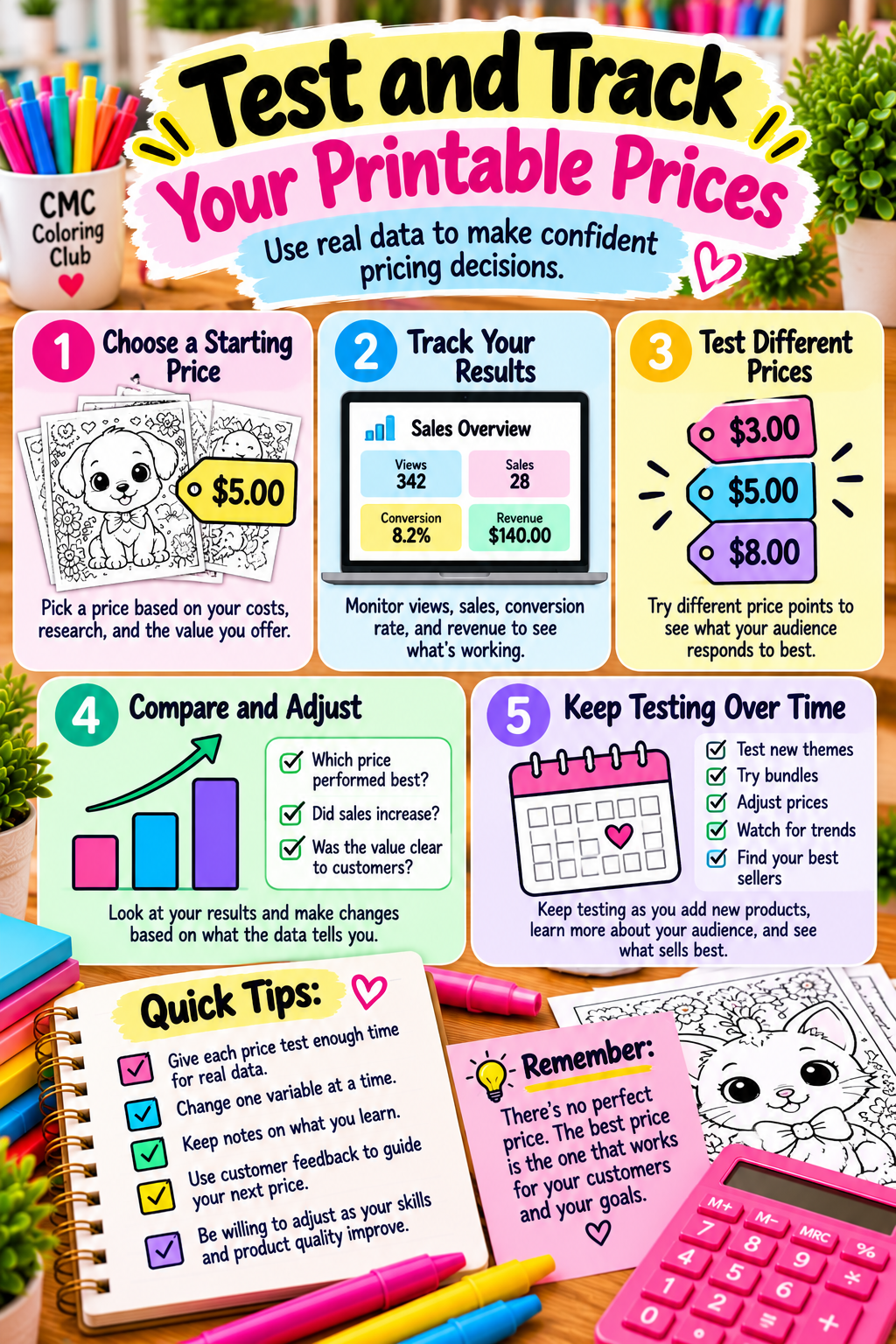
Once you’ve selected a reasonable starting price, publish the product and collect evidence.
Avoid changing your price every few days simply because sales haven’t appeared.
Instead, track the following information:
|
Metric |
What it tells you |
|---|---|
|
Product views |
How many visits the listing receives |
|
Sales |
How many purchases occur |
|
Conversion rate |
Sales divided by views |
|
Gross revenue |
Total selling price before deductions |
|
Transaction fees |
Amount deducted by the platform and payment processor |
|
Estimated proceeds |
Revenue remaining after those fees |
For example, suppose your product receives 10 views and zero sales.
That’s very little information.
You shouldn’t conclude that your price is too high based on those numbers alone.
Now suppose it receives 500 relevant visits and very few purchases.
You have more reason to investigate the listing, product-market fit, previews, customer expectations, and price.
Even then, price isn’t automatically the problem.
For more guidance on building your printable business, visit our Printable Business Blog for practical articles on product creation, testing and marketing.
Change One Major Variable at a Time
If you decide to test a lower price, record the original price, new price, dates, and results.
Try not to change the product description, cover image, traffic source, and price simultaneously.
Otherwise, you won’t know which change influenced the outcome.
For a small business with limited traffic, the testing period may need to extend beyond 30 days.
A calendar deadline doesn’t replace sufficient evidence.
Six Printable Pricing Mistakes to Avoid
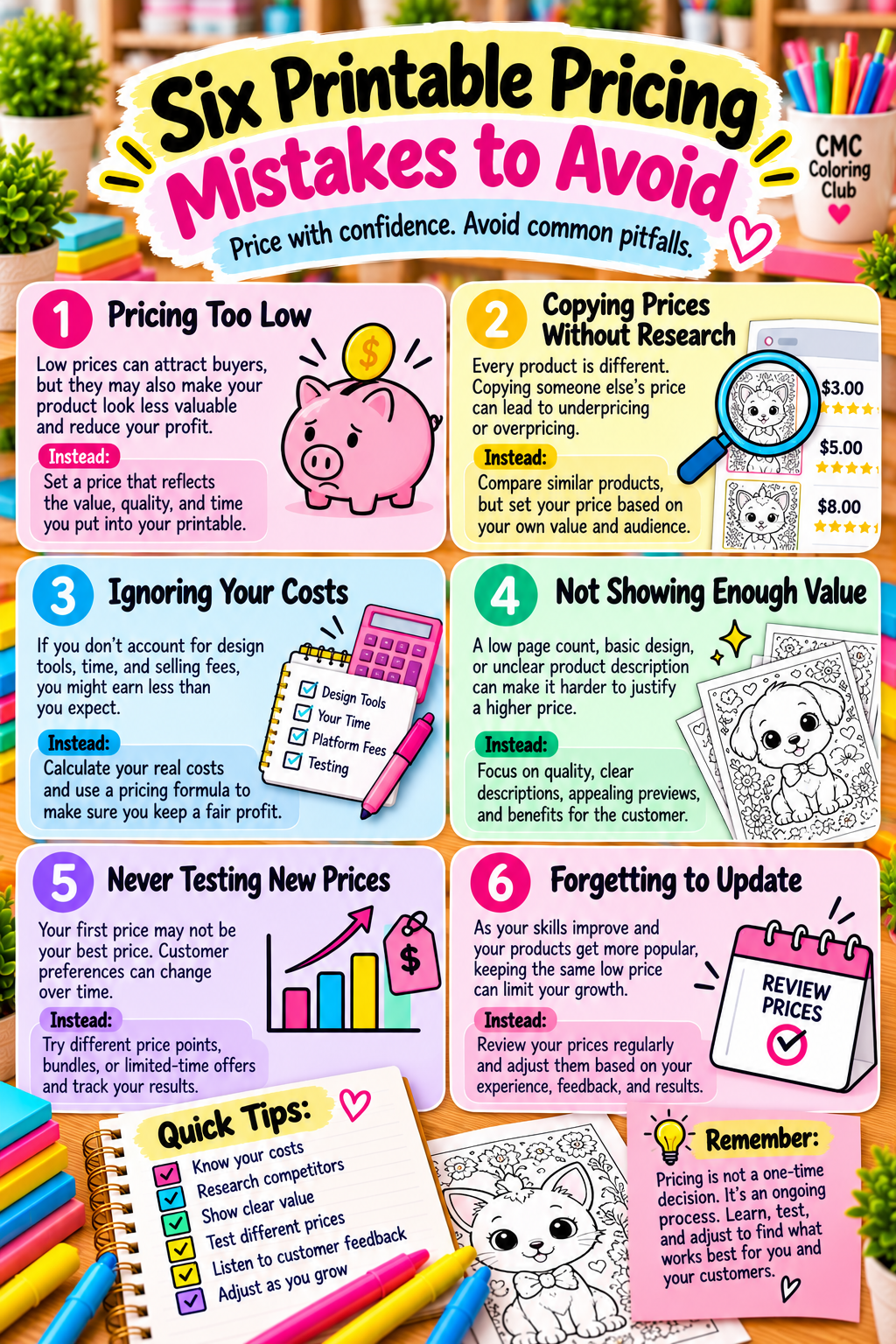
Mistake #1: Pricing only by page count.
A useful, well-organized 15-page product may be more valuable than a confusing 40-page collection.
Mistake #2: Ignoring transaction fees.
A low selling price can leave less money than expected after percentage and fixed fees.
Mistake #3: Copying competitors without comparing products.
You don’t know another seller’s expenses, sales volume, or profitability simply by looking at their listed price.
Mistake #4: Treating revenue as profit.
Revenue is the amount generated from sales before deductions. Profit requires accounting for the relevant business expenses.
Mistake #5: Changing prices before gathering enough information.
A product with very few visits hasn’t provided strong evidence about customer willingness to pay.
Mistake #6: Assuming a higher price automatically means higher earnings.
A higher price can improve proceeds per transaction, but it may also affect the number of purchases. You need to evaluate both.
You also need to check your files, product presenta
Your Five-Step Printable Pricing Checklist
Before publishing your next digital printable, complete these five steps:
- Define the customer and product value. Know who the printable serves and why they might want it.
- Calculate your development costs. Includes relevant tools, assets, testing, and production time.
- Estimate your selling fees. Use your platform’s current fee documentation and account for the sales channel.
- Compare similar products. Evaluate quality, features, audience, and customer convenience rather than price alone.
- Choose, record, and test a starting price. Track results before making changes.
You don’t need to predict the perfect price.
You need a reasonable starting point, a clear calculation, and a way to learn from what happens next.
That’s how you stop guessing and start making better pricing decisions.
Frequently Asked Questions
Related Reading
Want to improve your printable products before setting their prices? Explore these CMC Coloring Club resources:
- Printable Product Creation Guide — Learn the steps involved in developing digital printable products.
- How to Design Printables That Customers Love to Use — Improve the usability and presentation of your printable products.
- How to Test a Printable Before Selling — Check your files and customer experience before launching.
Before You Publish Your Printable
Pricing is only one part of getting a digital product ready for customers.
You also need to check your files, product presentation, download experience, and listing details.
CMC Coloring Club’s free Printable Pre-Launch Checklist helps you review those decisions before publishing.
If you’re building a printable business and want to follow the real work behind creating products, testing ideas, and improving a growing catalog, you can also join CMC Coloring Club’s Weekly Build Drops.
We’re building in public, sharing the process, and learning from actual results rather than promising overnight success.