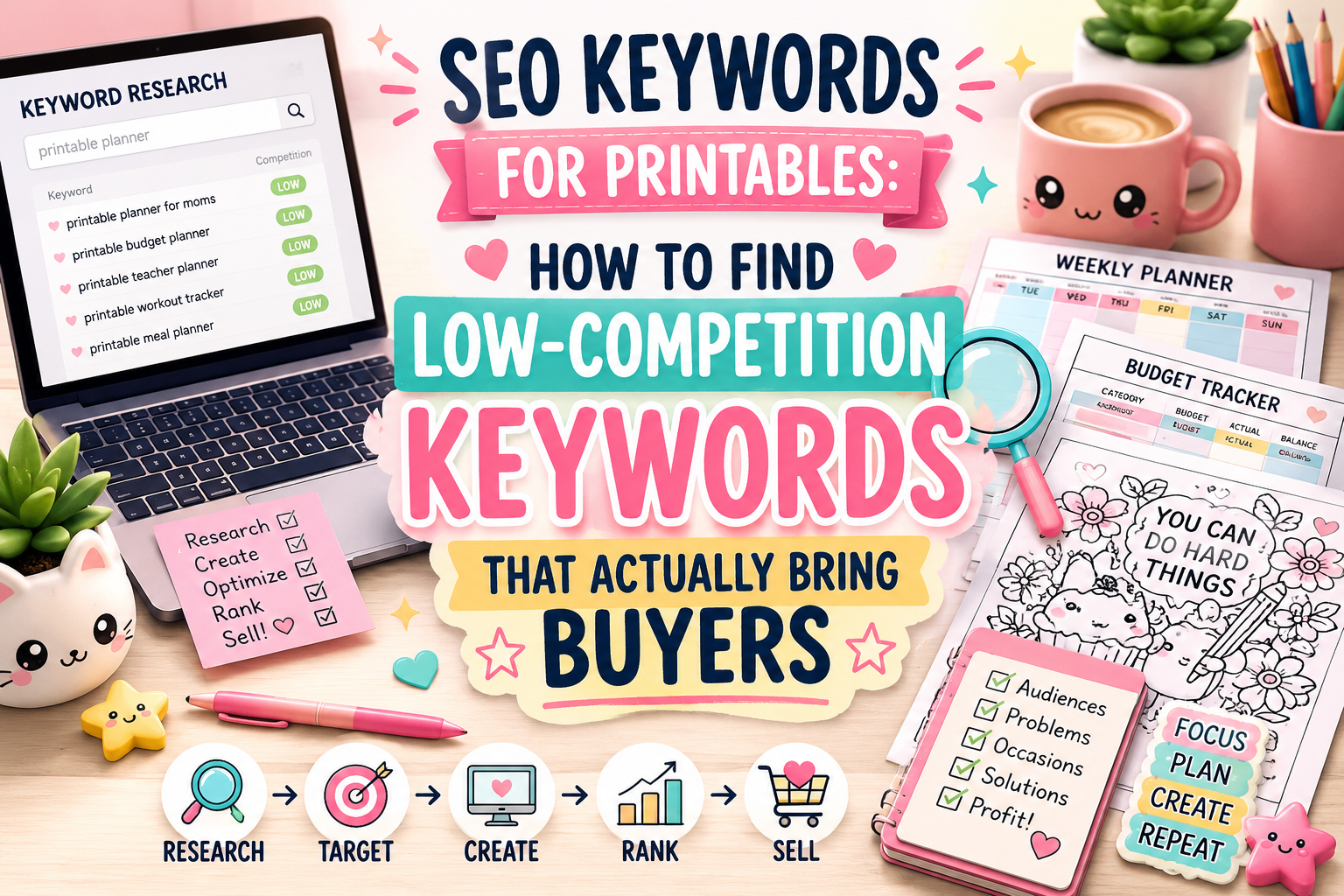
How to Find Low-Competition Keywords
Stop chasing high-volume keywords and discover the search terms real buyers use when they’re ready to download printable products.

Quick Summary: How to Find SEO Keywords That Attract Printable Buyers
If you’ve ever opened a keyword research tool and immediately searched for something broad like “printables” or “coloring pages,” you’re not alone. It’s one of the most common places new printable creators begin – and one of the biggest reasons many never gain meaning traction through organic search.
The reality is that profitable SEO isn’t built on chasing the largest search volume. It’s built on understanding the person sitting behind the keyboard.
Someone searching for “printables” could be looking for almost anything. Free downloads. Classroom worksheets. Party decorations. Home organization templates. Coloring books. Budget planners.
That’s a difficult audience to satisfy because their intent is scattered.
Now compare that with someone searching for:
Those searches tell a completely different story.
Each one reveals a specific need, a clear problem, and often a buyer who already knows exactly what they’re looking for. Instead of trying to reach everyone, you’re connecting with someone who’s already halfway to making a purchase.
The strongest SEO keywords for printables usually share a handful of important characteristics:
That shift – from broad traffic to qualified traffic – is where sustainable SEO begins.

Why Most Printable SEO Strategies Miss the Mark
There’s a pattern that shows up again and again.
A creator spends hours designing an incredible printable product. They upload it to their website or marketplace, write a short description, sprinkle in a few obvious keywords, and wait for visitors to arrive.
Weeks pass.
Nothing happens.
The assumption is usually that the market is too competitive.
More often than not, that’s not the real problem.
Many printable creators are taught to chase the biggest numbers. They look for highest monthly search volume and assume that’s where the opportunity lives.
It feels logical.
More searches should mean more customers.
But search engines don’t reward pages simply because they contain popular keywords. They reward pages that satisfy a very specific search intent better than the alternatives.
Think about these two searches.
printable planner
Now compare it with:
printable ADHD daily planner PDF
The first search could represent dozens of different intentions. The second leaves very little to the imagination.
Someone typing that longer phrase has already narrowed their options. They’re looking for a printable format. They have a specific audience in mind. They’ve identified a particular need. They’re much closer to making a decision.
That’s the kind of visitor you want.
Compared to broad keywords, these highly specific searches usually offer:
- stronger purchase intent
- significantly lower competition
- higher conversion potential
- better topical relevance
- easier opportunities to earn long-term rankings
Traffic by itself isn’t a meaningful goal.
Qualified traffic is.
One hundred visitors who are actively looking for exactly what you sell will almost always outperform ten thousand visitors who arrive with no clear intention of buying.
That’s the difference between building traffic and building a business.
Understanding Search Intent Before You Choose a Keyword
Keyword research isn’t really about keywords.
It’s about understanding why someone searched in the first place.
Every query represents a goal. Sometimes it’s obvious. Sometimes it’s hidden beneath just a few words.
When your content aligns with that underlying purpose, search engines notice – and readers stay longer because they immediately recognize that they’re in the right place.
Broadly speaking, printable searches tend to fall into four categories.
Informational Intent: “Help Me Understand”
These searchers aren’t ready to buy yet.
They’re trying to learn.
Examples include:
- how to organize printables
- what are printable coloring books
- how to print PDF planners
At this stage, your job isn’t to sell.
Your job is to become the trusted source that answers their question clearly and completely.
Trust built today often becomes tomorrow’s sale.
Commercial Investigation: “Help Me Compare My Options”
These users already know they need something.
Now they’re deciding which version is worth their time – or their money.
Searches often look like this:
- best printable budget planner
- printable homeschool planner reviews
- printable coloring books for adults
Comparison articles, buying guides, feature breakdowns, and curated recommendations perform exceptionally well here because they reduce uncertainty and make decision – making easier.
Transactional Intent: “I’m Ready to Buy”
This is where many printable businesses generate the majority of their revenue.
The searcher has already done most of the research.
Now they’re looking for the right product.
Examples include:
- printable wedding planner PDF
- buy printable coloring book
- printable meal planner download
Pages targeting transactional keywords should remove friction – not create it.
Clear product descriptions, quality previews, straightforward licensing information, and obvious calls to action help visitors move confidently from search to purchase.
Navigational Intent: “Take Me There”
Sometimes the search isn’t about discovering information at all.
It’s about reaching a specific destination.
Examples include:
- Etsy printable planner
- GumRoad coloring books
- Canva templates
These searches reinforce the importance of having a consistent presence across the platforms where your audience already spends time.
When your website, marketplace listings, and supporting content all reinforce one another, your brand becomes easier to discover – and easier to trust.

What Actually Makes a Keyword Low Competition?
One of the biggest misconceptions in SEO is that low competition automatically means low search volume.
It doesn’t.
A keyword can receive thousands of searches every month and still present a realistic ranking opportunity if the existing search results don’t fully answer what users are looking for. Likewise, a keyword with only a few hundred monthly searches can be nearly impossible to rank for if it’s dominated by highly authoritative websites that have spent years building trust.
Competition isn’t determined by search volume alone.
It’s determined by search volume alone.
It’s determined by how difficult it is to become the best answer.
That’s an important distinction.
When someone searches for a broad phrase like:
printable planner
Google has countless ways to satisfy that request. Large retailers, marketplaces, blogs, Pinterest boards, template websites, and productivity brands all compete for the same space.
Now narrow the search.
Consider phrases like:
- printable planner for nurses
- printable planner for ADHD adults
- printable planner for teachers
- printable planner for caregivers
The audience becomes smaller.
The intent becomes clearer.
The competition often becomes dramatically weaker.
At the same time, the value of each visitor increases because the search is no longer generic. It’s highly specific.
The strongest low-competition keywords usually have several characteristics in common:
- They describe a clearly defined audience.
- They solve on identifiable problem.
- They reflect real-world language instead of industry jargon.
- They closely match an actual product or solution.
- They allow one page to answer the search more thoroughly than competing content.
Instead of asking,
“How many people search for this?”
ask a better question:
“Can I create the most helpful page on the internet for this search?”
That’s the question Google increasingly rewards.
The Psychology Behind Buyer Searches
People don’t wake up thinking about keywords.
They wake up thinking about problems.
SEO becomes far more effective when you stop seeing search queries as strings of words and start seeing them as snapshots of human emotion.
Every printable search carries a story.
Someone searching for a printable anxiety journal isn’t looking for another PDF.
They’re looking for relief after a stressful day.
Someone searching for a printable chore chart usually isn’t shopping for a page with empty boxes. They’re searching for a way to bring a little more order to a chaotic household.
A search for a printable teacher planner often comes from someone trying to reclaim time during an already demanding school year.
The keyword is only the surface.
The motivation underneath is what matters.
|
Search Query |
Emotional Motivation |
|---|---|
|
Printable anxiety journal |
Find calm and reduce stress |
|
Printable chore chart |
Create structure at home |
|
Printable coloring book |
Relax and unplug mentally |
|
Printable teacher planner |
Save time and stay organized |
|
Printable budget binder |
Feel more in control financially |
|
Printable wedding checklist |
Reduce overwhelm before a major event |
This is why successful SEO isn’t just technical.
It’s empathetic.
The highest-performing pages answer both questions simultaneously:
- What did the visitor type?
- Why did they type it?
When your content addresses both, readers stay longer, engage more deeply, and are far more likely to trust your recommendations.

The Four Types of Printable Keywords Every Business Should Target
Not every keyword serves the same purpose.
The healthiest SEO strategy blends several keyword categories together, allowing your website to capture buyers at different stages of their journey while steadily building topical authority.
Think of these categories as the foundation of your keyword ecosystem.
1. Product Keywords
These describe exactly what you’re selling.
Examples include:
- printable coloring book
- printable planner
- printable worksheet
- printable puzzle book
These keywords establish topical relevance and help search engines understand the products your website specializes in.
Without them, your niche becomes harder to define.
2. Problem Keywords
People rarely buy printables simply because they enjoy collecting PDFs.
They buy them because they’re trying to solve something.
Problem-focused keywords connect directly to those needs.
Examples include:
- stress relief coloring pages
- homeschool organization printable
- budgeting printable PDF
Notice how the focus shifts away from the product and toward the outcome.
That’s often where purchase decisions begin.
3. Audience Keywords
Sometimes the most important part of the search isn’t the product at all.
It’s who the product is designed for.
Examples include:
- printable for teachers
- printable for seniors
- printable for kids
- printable for adults
Audience modifiers instantly narrow search intent and often create far less competitive opportunities than broad product terms alone.
4. Occasion Keywords
Timing influences search behavior more than many creators realize.
Seasonal demand creates recurring opportunities throughout the year.
Examples include:
- Christmas printables
- Halloween coloring pages
- Mother’s Day cards
- summer activity sheets
These keywords allow you to capture predictable waves of interest while expanding your site’s overall topical coverage.
The real opportunity appears when these four categories begin working together.
Instead of targeting isolated keywords, you start creating combinations that mirror how real people search.
Examples include:
- printable Halloween coloring book for adults
- printable Christmas planner PDF
- stress relief coloring pages for seniors
- homeschool planner printable download
From a single product idea, dozens – ore even hundreds – of natural long-tail keywords begin to emerge.

How to Find Low-Competition Keywords for Printables
Finding profitable keywords isn’t about discovering a hidden database.
It’s about learning to think like your customer.
The process is surprisingly simple once you stop chasing isolated keywords and start building outward from a single idea.
Step 1: Begin With One Core Product
Everything starts with one clear topic.
For example:
Printable Coloring Book
Don’t overcomplicate this first step.
Choose the broad product you’re trying to rank.
Step 2: Expand Naturally
Now begin asking simple questions.
How might someone describe this product differently?
What words naturally belong alongside it?
Your list might grow into phrases such as:
- printable coloring book PDF
- printable coloring pages
- printable coloring book download
- printable coloring pages for adults
- relaxing printable coloring book
At this stage, you’re building semantic relevance rather than forcing keywords.
Step 3: Add Audience Modifiers
Net, think about who the printable was created for.
Examples include:
- for teachers
- for moms
- for adults
- for seniors
- for teens
Every audience modifier creates a new branch in your keyword ecosystem.
Step 4: Add Problem Modifiers
Now layer in the reason someone wants the printable.
Examples include:
- stress relief
- anxiety
- mindfulness
- organization
- productivity
This is often where buying intent becomes significantly stronger because the search reflects a desired outcome rather than a generic product.
Step 5: Add Occasion Modifiers
Finally, think seasonally.
Many printable businesses generate consistent traffic by anticipating recurring events throughout the year.
Examples include:
- Halloween
- Christmas
- Easter
- Summer
- Fall
- Birthday
Combining these elements produces highly targeted search phrases like:
- Halloween printable coloring pages for adults
- stress relief coloring pages PDF
- printable Christmas coloring book
- mindfulness coloring pages printable
What started as one simple keyword has now evolved into an entire library of search opportunities – all closely connected, highly relevant, and aligned with genuine buyer intent.
Build Topic Clusters That Turn Articles Into an Authority Website
If there’s one shift that’s transformed SEO over the past few years, it’s this:
Google no longer evaluates pages in isolation.
It evaluates websites.
More specifically, it looks for signs that a website consistently demonstrates expertise around a subject – not just that it published one well-written article.
That’s where topic clusters become incredibly powerful.
Instead of writing one article about printable SEO and moving on to the next unrelated idea, you create an ecosystem of content that naturally connects together. Every article answers a different question, yet each one reinforces the others.
Think of your content like a neighborhood instead of a collection of houses scattered across the country.
For this topic, your pillar article is:
SEO Keywords for Printables
From there, you expand outward into supporting articles that explore related questions in greater depth.
Examples include:
Each article should naturally reference the others when ever it improves the reader’s experience.
Someone learning about keyword research will likely benefit from understanding search intent. A reader exploring Google rankings may also want to learn how Etsy SEO differs. Someone researching coloring book keywords may eventually need guidance on creating topical authority.
These aren’t forced internal links.
They’re logical next steps.
Over time, this interconnected structure helps search engines recognize your website as a comprehensive resource rather than a series of disconnect blog posts.
That’s exactly the type of topical depth modern search algorithms increasingly reward.
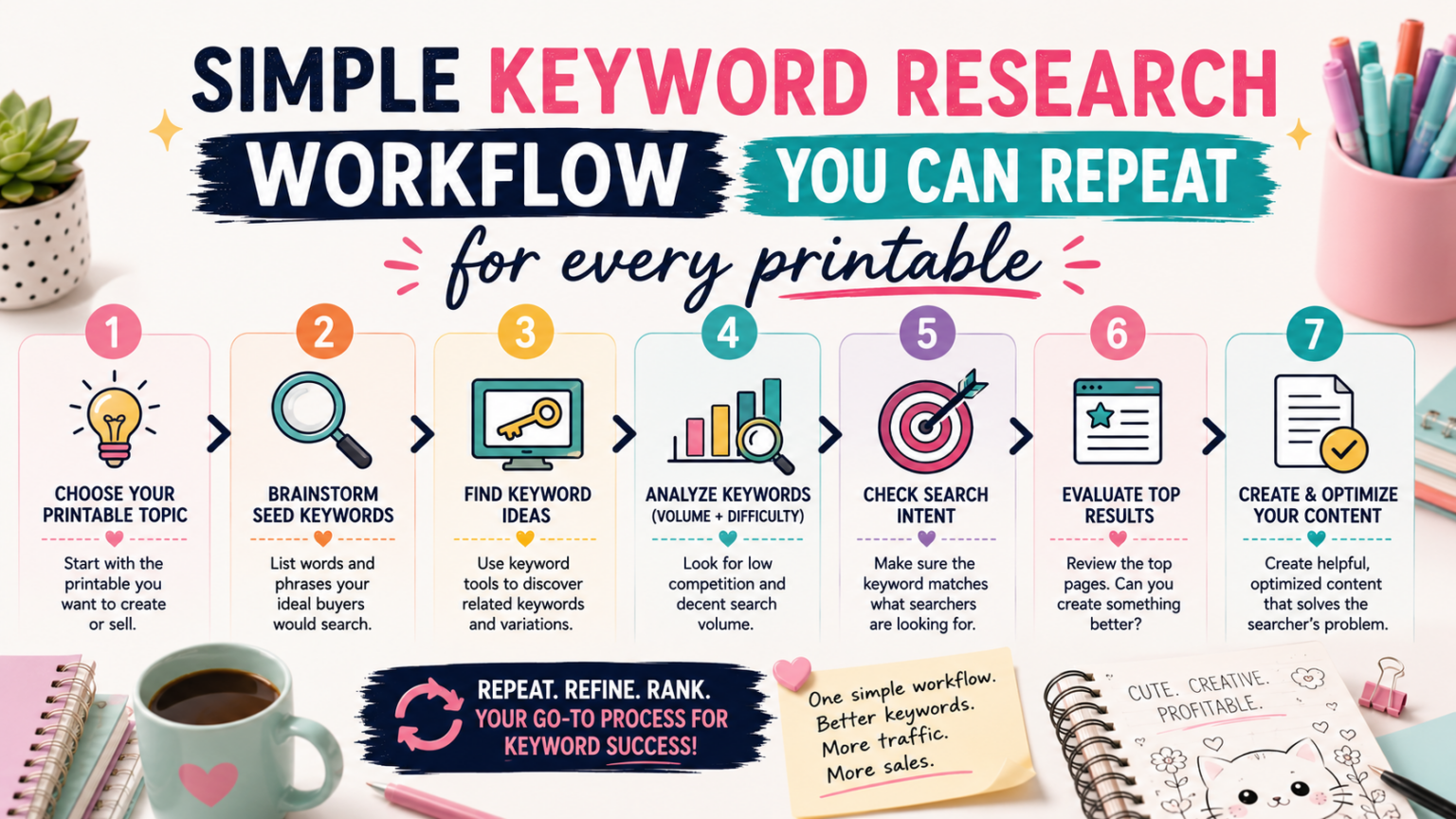
A Simple Keyword Research Workflow You Can Repeat for Every Printable
Keyword research often feels overwhelming because people assume they need expensive software or years of SEO experience
In reality, the most effective workflows are surprisingly simple.
The goal isn’t to generate thousands of random keywords.
The goal is to uncover the language real buyers naturally use when they’re searching for products like yours.
Here’s a repeatable process you can apply to nearly every printable you create.
Step 1: Start With the Product
Begin with the simplest possible description.
For example:
Printable Coloring Book
Don’t worry about making it more specific yet.
This is your foundation.
Everything else will grow from here.
Step 2: Brainstorm the Problems It Solves
People buy solutions – not files.
Ask yourself:
“Why would someone want this printable?”
Your answers may include:
Notice that none of these describe the product itself.
They describe the transformation the customer hopes to experience.
Those motivations often become power keyword modifiers.
Step 3: Define the Audience
Now think about who benefits most.
Examples include:
The more precisely you understand your audience, the easier it becomes to discover search phrases that larger competitors frequently overlook.
Step 4: Layer in Occasions and Seasons
Search behavior changes throughout the year.
People don’t search for the same things in October that they search for in March.
Adding seasonal intent dramatically expands your keyword opportunities.
Examples include:
Many printable businesses build predictable traffic simply by publishing content well before demand peaks.
Step 5: Combine Everything Naturally
This is where the real magic happens.
Instead of forcing keywords together, imagine how someone would naturally type their search into Google.
Examples include:
Each phrase reflects a specific audience, a clear need, or a defined occasion.
Collectively, they create dozens of content opportunities from a single product idea.
Repeat this process consistently and you’ll never run out of topics worth targeting.
The SEO Mistakes That Quietly Hold Printable Businesses Back
Most printable businesses don’t struggle because their products aren’t good.
They struggle because small SEO mistakes compound over time.
Individually, each one seems harmless.
Together, they make it much harder for search engines – and potential buyers – to understand what your website offers.
Here are some of the most common issues.
Chasing Search Volume Instead of Buyer Intent
A keyword with 30,000 monthly searches isn’t automatically better than one with 300.
If those 300 visitors are actively looking for exactly what you sell, they’ll almost always generate better results than thousands of untargeted visitors.
Intent wins.
Every time.
Publishing One-Off Articles With No Supporting Content
One excellent article is valuable.
A connected library of related articles is exponentially more powerful.
When your content consistently covers every angle of a topic, your authority grows naturally.
That’s much harder for competitors to replicate.
Reusing Generic Product Descriptions
Search engines reward originality.
If every product page follows the same template with only a few words changed, your content becomes difficult to distinguish from hundreds of similar pages.
Instead, describe each printable in a way that reflects its unique purpose, audience, and value.
Ignoring Internal Links
Every new article creates another opportunity to strengthen your website.
Helpful internal links guide readers toward related content while helping search engines understand the relationships between your pages.
Think of them as signposts rather than SEO tricks.
Publishing Thin Content
A short article isn’t necessarily a weak article.
But content that barely answers the reader’s question rarely earns lasting visibility.
Depth matters.
Context matters.
Completeness matters.
When someone leaves your page feeling like they don’t need another search result, you’ve done your job well.
Forgetting Image SEO
Printable businesses rely heavily on visuals.
That makes image optimization even more important.
Use descriptive filenames.
Write meaningful alt text.
Compress images for faster loading.
These small improvements enhance accessibility while giving search engines additional context about your content.
Ignoring Titles and Headings
Headings do more than organize a page.
They guide readers through the story while signaling topic hierarchy to search engines.
Strong headings improve readability, encourage scrolling, and reinforce your primary keyword naturally throughout the article.
Following Every Trend
Not every trending topic deserves a place on your website.
If a subject doesn’t support your niche or strengthen your topical authority, it may generate temporary traffic – but very little long-term value.
Consistency almost always beats randomness.
A focused website that steadily expands its expertise will outperform one that constantly chases the latest viral topic.
How AI Search iIs Changing Keyword Research for Printable Businesses
Search has changed dramatically over the past few years – and it’s still evolving.
People no longer search using only short, robotic phrases. They’re asking complete questions, describing specific situations, and expecting direct answers. Whether they’re typing into Google, speaking to a voice assistant, or using an AI-powered search experience, the expectation is the same:
“Understand what I mean, not just what I typed.”
That’s good news for printable creators who produce genuinely helpful content.
Years ago, someone might have searched for:
Printable Planner
Today, they’re much more likely to ask questions like:
These searches are longer, more conversational, and packed with context.
Instead of focusing on exact-match keywords, modern search engines analyze relationships between concepts, user intent, and topical relevance. They recognize that someone asking about a budget planner, financial organization, and expense tracker is often exploring the same broader topic.
That’s why semantic coverage matters so much.
Rather than writing an article that repeats one keyword dozens of times, build a resource that naturally answers the surrounding questions a reader is likely to have.
Ask yourself:
- What would someone wonder next?
- What misconception should I clear up?
- What examples would make this easier to understand?
- What related topics naturally belong here?
When your content mirrors the way real conversations unfold, it becomes valuable not only to readers but also to search engines that increasingly prioritize context over repetition.
The goal isn’t to write for algorithms.
It’s to create the most complete answer for the person asking the question.
Ironically, that’s also what today’s algorithms reward.

How to Increase Your Chances of Earning Featured Snippets
Featured snippets occupy some of the most valuable real estate in search results.
They’re often the first answer users see – and they frequently become the source material for AI-generated summaries as well.
While there’s no guaranteed formula for earning one, certain content patterns consistently perform well.
Begin important sections by answering the question directly before expanding into deeper explanation.
For example:
What is a low-competition keyword?
A low-competition keyword is a search phrase with relatively little high-quality competition, making it easier for well-optimized content to rank while still attracting relevant visitors.
That concise answer gives search engines exactly what they need.
Afterward, you can expand with examples, context, and practical advice.
Throughout your articles, include elements that are naturally easy to extract, suc as:
- concise definitions
- numbered processes
- bullet-point summaries
- comparison tables
- checklists
- question-and-answer sections
- short explanatory paragraphs immediately below headings
These formatting choices aren’t just helpful for search engines.
They’re helpful for readers.
People scan before they read.
Well-structured content allows them to quickly find the answer they’re looking for while encouraging them to continue exploring the rest of the article.
The easier your content is to navigate, the longer visitors tend to stay – and engagement remains one of the strongest indicators that your page successfully satisfied their search.
Internal Linking: The Quiet SEO Advantage Most Printable Websites Overlook
Internal linking doesn’t receive the same attention as keyword research or backlinks.
It should.
Every article you publish creates another opportunity to strengthen the rest of your website.
Done well, internal links accomplish several goals at once.
They help readers discover related information.
They encourage longer browsing sessions.
They establish relationships between topics.
And they help search engines understand the structure of your website.
Imagine someone arrives on this article because they’re researching SEO keywords for printables.
Once they’ve learned how to identify profitable keywords, what question naturally comes next?
Maybe they’re wondering how to optimize Etsy listings.
Perhaps they’re curious about Google versus Etsy SEO.
Or maybe they want practical advice for ranking printable coloring books.
Each of those questions deserves its own article.
Within this guide, you could naturally reference resources such as:
- Beginner’s Guide to Selling Printables
- Printable Product SEO Checklist
- How to Optimize Printable Product Images
- Etsy SEO vs. Google SEO
- Best Blog Topics for Printable Businesses
- How to Price Printable Products
- How to create Printables That Sell
- Pinterest SEO for Printables
- AI Tools for Printable Creators
- Building Topical Authority With Content Clusters
Notice the pattern.
Every recommendation feels like the logical next step – not an interruption.
That’s the kind of internal linking strategy readers appreciate because it continues helping them solve the net problem.
As your library grows, these connections create a network of expertise that becomes increasingly difficult for competitors to replicate.
Your Next Step Toward Smarter Printable SEO
Finding profitable SEO keywords for printables isn’t bout uncovering a secret list that nobody else knows exists. It’s about understanding the people behind the searches and creating content that genuinely answers their questions better than anyone else.
Throughout this guide, you’ve seen how low-competition keywords, search intent, topical authority, and strategic content clusters work together to create a stronger SEO foundation. Instead of competing for broad, highly saturated phrases, you can focus on the specific searches that attract readers who are actively looking for exactly what you offer.
Remember, successful printable businesses rarely grow because of one viral article or one lucky keyword. They grow because every blog post, product page, and internal link builds on the last, creating an expanding library of helpful content that earns trust with readers and authority with search engines.
Start with one product. Research one audience. Solve one problem exceptionally well. Then repeat the process consistently. Over time, those individual pieces become a content ecosystem that continues attracting qualified traffic long after it’s been published.
SEO isn’t about chasing algorithms. It’s about becoming the most helpful answer for the people you want to serve. When you make that your priority, better rankings, more engaged readers, and stronger long-term growth often follow naturally.
Before You Go…Grab My Free Kawaii Mega Sample Pack
Reading about SEO is one thing. Seeing a professionally designed printable product in action is another.
If you’re looking for inspiration – or simply want something fun to print – download my FREE Kawaii Mega Sample Pack. Inside, you’ll find a collection of printable coloring pages pulled from multiple Color Me Crazy Club books, giving you a real look at the design style, print quality, and overall experience.
Whether you’re a coloring enthusiast or you’re researching ideas for your own printable business, it’s a great way to explore what’s possible.
Download the FREE Kawaii Mega Sample Pack and start coloring in minutes.
Frequently Asked Questions
Join the Weekly Build Drops
If you enjoy practical, behind-the-scenes insights instead of generic marketing advice, Weekly Build Drops was created for you. Each week I share what I’m actually building – from new printable products and SEO experiments to lessons learned, marketing wins, mistakes worth avoiding, and the systems I’m using to grow Color Me Crazy Club in public. No hype. Just real progress, practical ideas, and resources you can put to work in your own printable business.