
From Invisible to Unstoppable: The AI-Era SEO System Printable Businesses Can’t Afford to Ignore
One-line subhead text
AI‑era SEO for printable businesses isn’t about adding keywords and uploading more—it’s about building a discoverability system search engines can trust.
There’s a quiet kind of frustration that almost every printable creator runs into eventually.
It usually starts the same way: you spend hours designing planners, coloring pages, templates, trackers, journals, worksheets, or bundles. You upload everything carefully. You tweak thumbnails. Rewrite titles. Add keywords. Maybe you even post consistently for months.
And then… nothing. A few clicks here. A random sale there. A Pinterest spike that disappears as fast as it came. Long stretches where it feels like your shop exists in complete silence while other creators somehow keep showing up everywhere.
That silence is what breaks most people. Not because they lack talent. Not because their products are bad. But because modern search doesn’t reward effort the way we were taught it would.
Quick Version
SEO for printables isn’t “upload more and hope.” It’s building a connected discoverability system search engines trust. Focus on helpful search content, Pinterest amplification, and email capture so traffic compounds instead of disappearing.
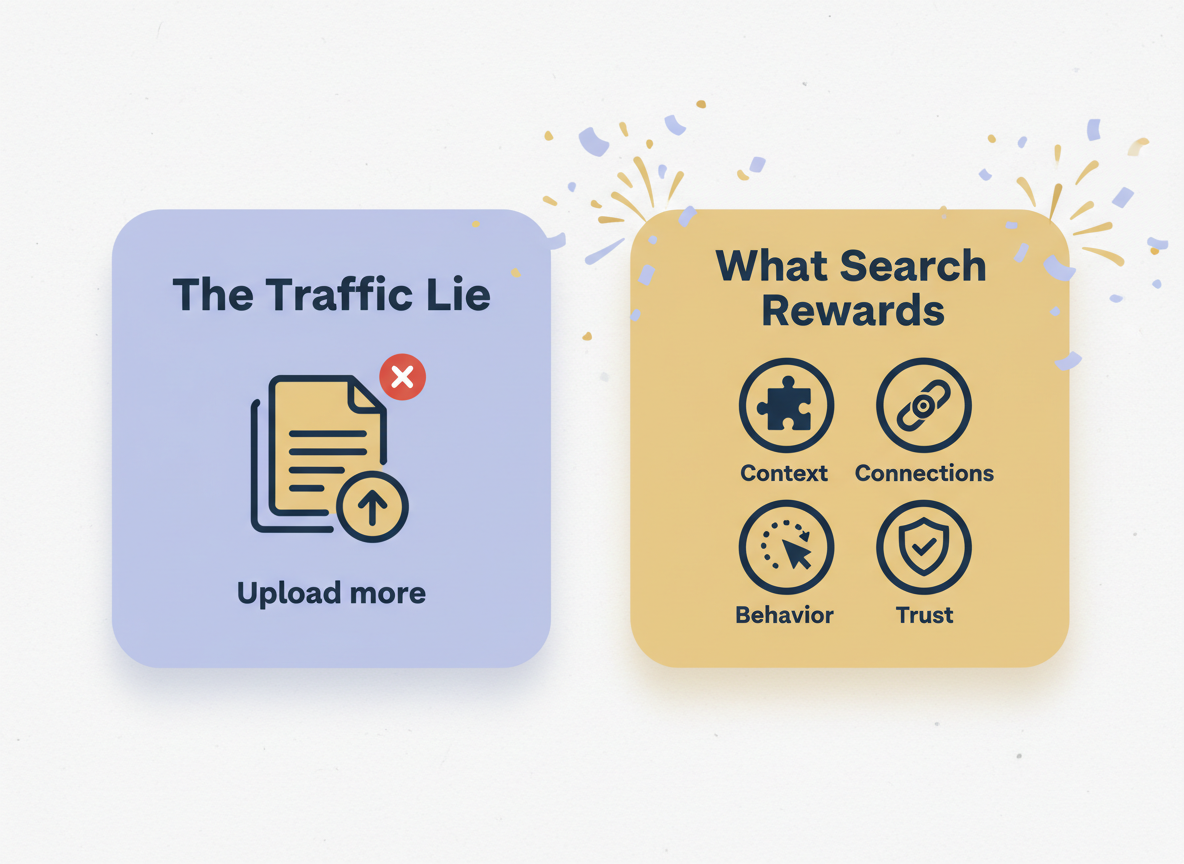
SEO for printables isn’t “add keywords and upload more.” It’s building a discoverability system search engines can trust.
That system is: (1) helpful search content that answers real questions, (2) Pinterest that amplifies the right topics, and (3) email capture so your traffic doesn’t disappear when algorithms change.
In the AI era, shallow content blends in. Depth, structure, and connected topics stand out.
The internet changed while most creators were still playing by old rules.
Search engines aren’t just indexing pages and matching keywords anymore. They’re interpreting meaning, measuring trust, watching behavior, and trying to predict whether your content will actually satisfy the person who searched. AI-powered search systems now decide which creators are authoritative enough to surface, summarize, recommend, and amplify.
And printable businesses sit right in the middle of that shift.
Because this isn’t just about SEO anymore. It’s about discoverability architecture.
The creators building sustainable traffic today aren’t winning because they upload more products. They’re winning because they’ve built systems that make their content hard to ignore.
Why Most Printable Shops Stay Invisible (and Exhausted)
A huge number of printable sellers are trapped inside the same assumption:
“If I just make more products, eventually traffic will come.”
It sounds reasonable. More listings should create more opportunities, right? If you’re starting from zero, go to Start Here and follow the simplest path first.
But search ecosystems don’t reward volume the way marketplaces want you to believe they do. Google doesn’t care how many PDFs you uploaded this week. Pinterest doesn’t care how hard you worked. AI search engines definitely don’t care how long something took to create.
They care about signals: context, relationships between ideas, behavior patterns, and authority.
That’s why a tiny printable business with 25 strategically connected products can outperform a massive shop stuffed with hundreds of disconnected listings. Search engines are constantly trying to answer one question:
“Does this creator actually understand this topic deeply?”
And that question changes everything.
Why uploading more products usually changes nothing
Most printable shops don’t have a product problem. They have a discovery problem.
A printable sitting on Etsy without supporting content is like putting a billboard in the middle of the woods and hoping traffic magically appears around it.
Search needs context. A single “budget planner printable” listing doesn’t mean much on its own. But when that product is surrounded by content that supports the same person and the same problem, everything changes. Now search engines don’t see “a random PDF.” They start seeing expertise.
That’s the shift most creators never make.
Platforms push content. Search ecosystems interpret meaning.
Social platforms distribute content temporarily. Search ecosystems evaluate it continuously.
Instagram rewards interruption. TikTok rewards stimulation. Pinterest rewards discoverability. Google rewards semantic depth. AI search rewards contextual completeness.
A viral social post might bring attention for 24 hours. A well-built article connected to a larger ecosystem can bring traffic for years while you sleep.
One is exposure. The other is infrastructure. And infrastructure compounds.
AI‑Era SEO for Printable Businesses: The New Rules
Traditional SEO was mostly about ranking webpages.
Now we’re moving into something bigger: Generative Engine Optimization (GEO) — becoming the source AI systems trust enough to pull from.
AI-powered search doesn’t just list websites anymore. It summarizes answers inside the search results. It predicts what users need. It tries to reduce clicks.
So your content has to do more than “contain keywords.” It has to demonstrate understanding.
Search systems increasingly reward content that feels:
- complete
- layered
- connected
- experience-driven
- genuinely useful
If your article sounds interchangeable with thousands of others, search engines have very little reason to prioritize it. In the AI era, depth becomes your moat.
AI search doesn’t think in keywords alone
Search engines now analyze relationships between concepts and intent. They understand that “printable planners,” “organization systems,” “productivity routines,” “time management,” and “habit tracking” live in the same neighborhood.
That means you’re not just writing isolated blog posts anymore. You’re building a connected web of meaning. The more context you create around a topic, the easier it becomes for algorithms to trust you inside that category.
At first, that trust feels invisible. Then suddenly, everything starts ranking faster.
Viral traffic fades. Topical authority sticks.
A lot of creators chase spikes because spikes feel exciting: one viral Pinterest pin, one trending Reel, one temporary surge.
But spikes disappear fast.
Topical authority behaves differently. When your printable business consistently publishes related content around one category, search engines start associating your brand with that topic itself.
That’s where real leverage starts happening. Not when one post performs well — but when your whole ecosystem becomes easier to rank because search engines already trust the environment around it.
That’s the real shift behind AI era SEO for printable businesses.
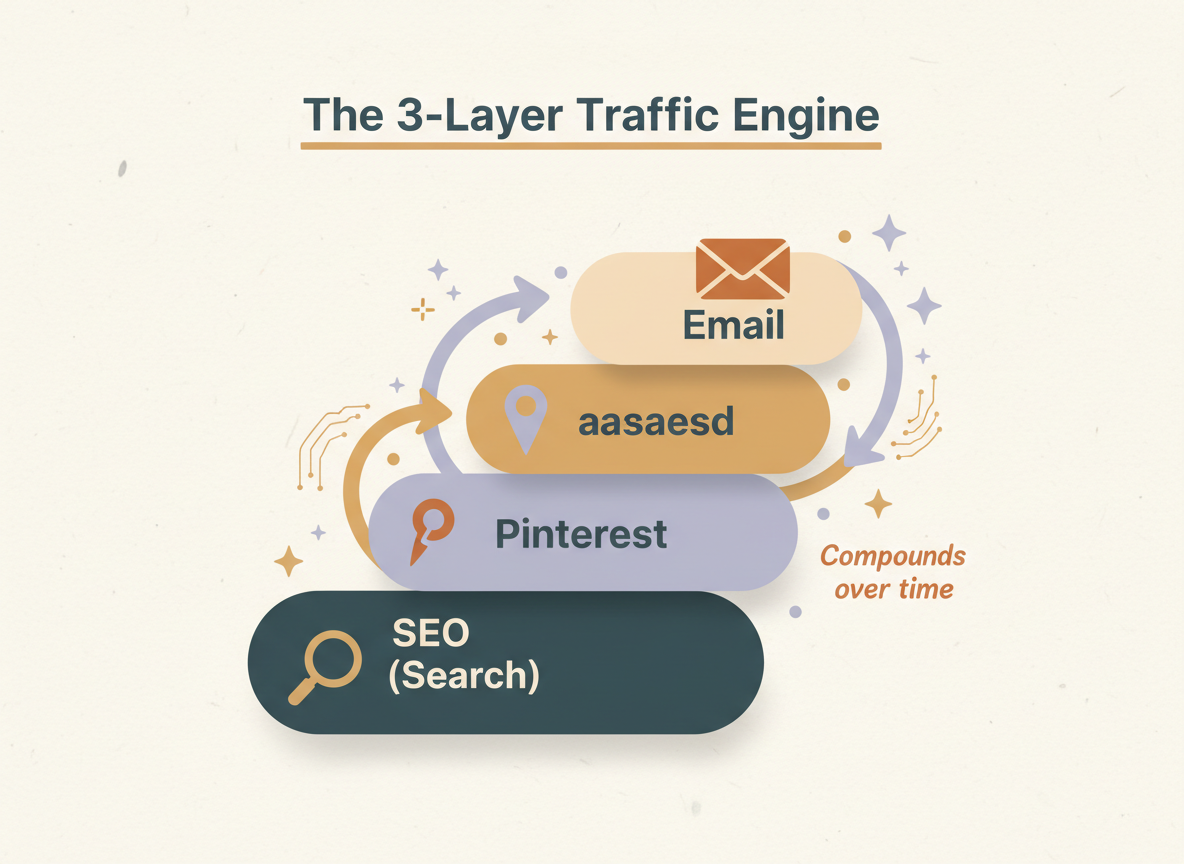
The 3‑Layer Traffic Engine That Actually Works for Printables
This is the practical side of AI era SEO for printable businesses: build content that ranks, amplify it, then keep the traffic you earn.
Layer 1 — Search-based discovery
A lot of creators chase spikes because spikes feel exciting: one viral Pinterest pin, one trending Reel, one temporary surge.
But spikes disappear fast.
Topical authority behaves differently. When your printable business consistently publishes related content around one category, search engines start associating your brand with that topic itself.
That’s where real leverage starts happening. Not when one post performs well — but when your whole ecosystem becomes easier to rank because search engines already trust the environment around it.
Layer 2 — Pinterest amplification
Pinterest operates differently than almost every other platform online. Pinterest behaves less like social media and more like visual future-planning.
People don’t open Pinterest to argue. They open it to imagine: a calmer home, a more organized week, a more creative version of themselves.
That psychology matters for printables because most printables are tied to identity transformation:
- planners represent control
- coloring pages represent calm
- budget printables represent stability
- journals represent self-reinvention
The strongest Pinterest strategies don’t just show the product. They show the outcome. The pin isn’t selling a printable — it’s selling possibility.
If you want my exact workflow, I keep it updated on my Tools I Use page.
Layer 3 — Email capture creates stability
Traffic without retention is fragile.
Search traffic is rented. Email is owned. That distinction becomes more important every year.
That’s why my main CTA is Weekly Build Drops—one email, one next step, every week.
Smart printable brands use free libraries, starter kits, mini packs, and subscriber-only downloads to turn search visitors into long-term audience relationships. Returning visitors trust faster, click deeper, and buy more consistently — and those behavior signals strengthen your entire ecosystem.
Build SEO Content Search Engines Trust
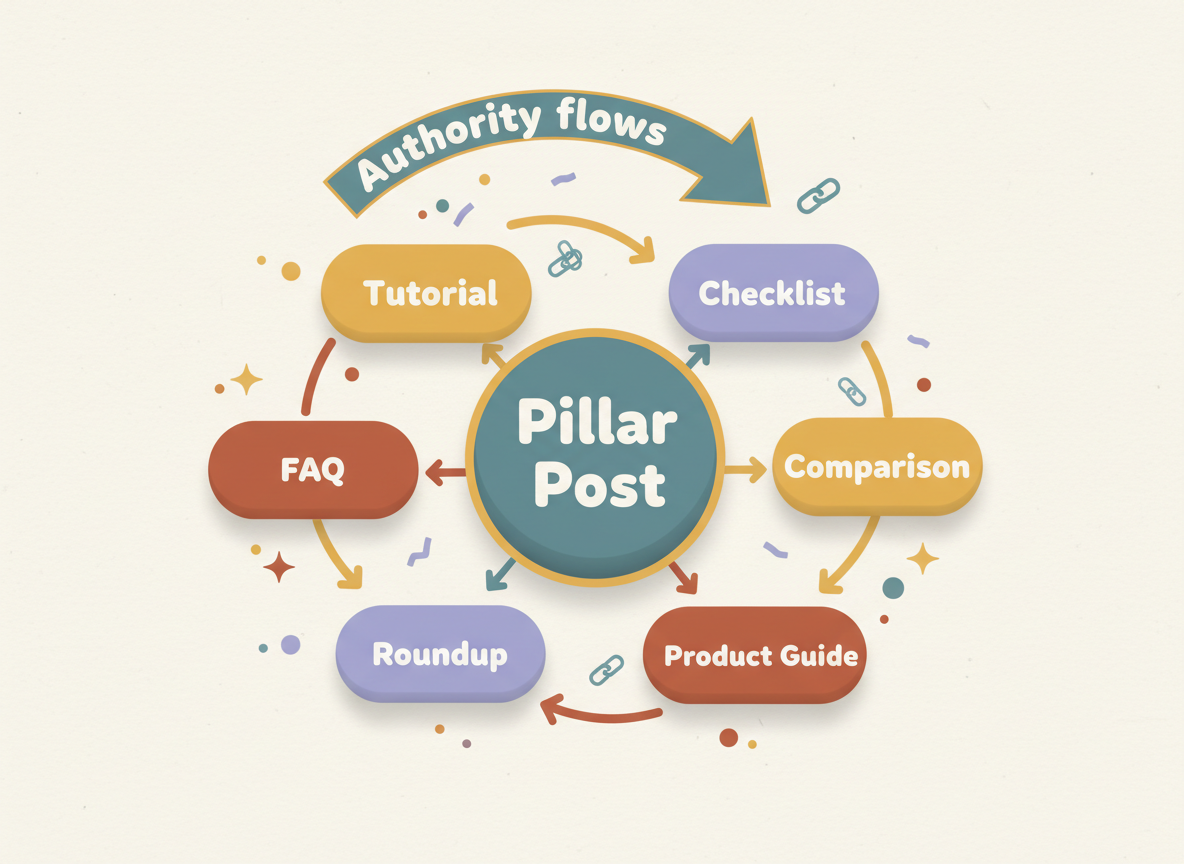
The hidden layer: entity mapping
Modern SEO revolves around entities — recognized concepts search engines understand contextually.
For printables, entities include budgeting, journaling, mindfulness, planners, homeschooling, coloring books, productivity, and self-care.
When your content naturally reinforces related entities over time, search engines start building a knowledge map around your brand. That’s why random blogging weakens growth. Disconnected content creates fragmented authority. Strategic clusters create reinforcement.
Internal linking builds quiet authority loops
Internal links aren’t just navigation. They’re contextual signals.
Every internal link teaches search engines which pages matter, how topics connect, and where authority flows. A printable site with strong internal linking feels structurally intelligent: tutorials support product pages, FAQs support tutorials, comparison articles support buyer intent.
Everything reinforces everything else. That’s what systems look like.
Thin content is becoming risky
There was a time when short SEO articles worked surprisingly well. That era is fading fast.
AI can summarize generic content instantly. So shallow articles increasingly disappear into the background because they don’t add unique value.
Search engines are prioritizing content that feels like it came from someone who’s actually been in the problem:
- lived understanding
- adjacent problem-solving
- emotional intent
- follow-up questions answered before they’re asked
The future belongs to creators willing to go deeper — not louder.
Blog Content Structures That Generate Evergreen Traffic
Tutorial content still dominates because it matches action-based intent. Keyword roundups expand your reach because they naturally create semantic density. Ecosystem posts help people understand how products work together (which increases trust and conversions). Problem-solution articles validate frustration before offering clarity. Comparison content captures high-intent visitors near decision points.
The common thread: the best posts don’t just describe a printable. They help someone move from “stuck” to “better.”
The Pinterest–SEO Feedback Loop Most Creators Miss
Pinterest content has a long shelf life. A single optimized pin can generate clicks months later because Pinterest indexes visual search intent over time. That makes pins traffic assets, not temporary posts.
And Pinterest can also validate SEO topics before you scale them. Saves and clicks often reveal emotional resonance and urgency — which helps you decide what to write next.
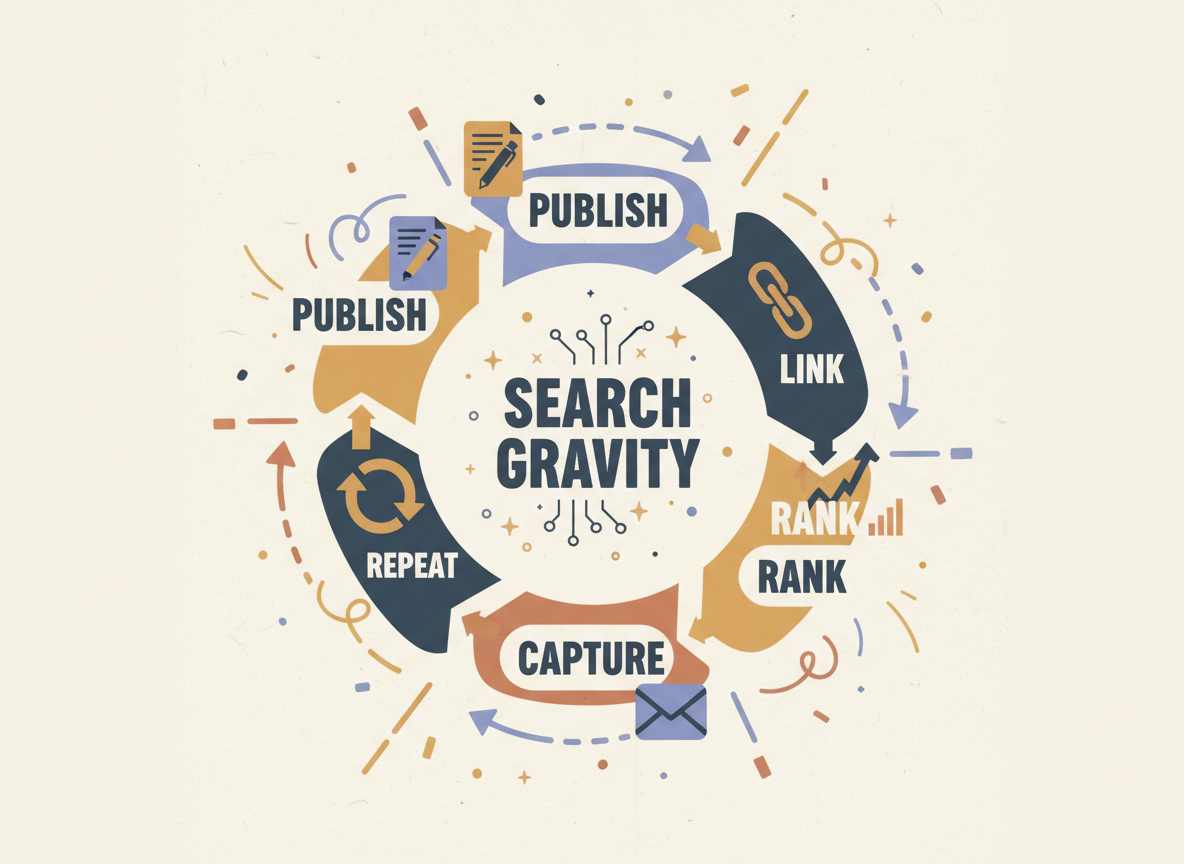
How to Build “Search Gravity” Around Your Brand
Random content weakens momentum because search engines can’t tell what you stand for. Focused clusters create clarity, and clarity builds trust.
Repetition isn’t a problem — it’s reinforcement. Many creators fear repeating themselves, but search engines interpret strategic repetition as expertise. Consistency beats perfection because it creates crawl patterns, freshness signals, and expectation loops.
Over time, that’s how traffic stops feeling random and starts feeling engineered.
SEO Metrics That Actually Matter
You don’t need a complicated dashboard to start. You need a few signals that tell you whether your ecosystem is strengthening:
- impressions (often rise before clicks)
- click depth (do people explore more than one page?)
- email capture (are you building stability?)
- returning visitors (are people coming back?)
- ecosystem expansion (are your products and posts connecting into a system?)
The Future of Printable SEO Belongs to System Builders
AI tools are lowering the speed barrier for content creation. That means “publishing a lot” won’t be the differentiator for long.
Strategy will.
The creators who win won’t necessarily publish the most content. They’ll publish the most structurally intelligent content — content that matches intent, answers follow-up questions, connects to related topics, and turns traffic into an audience.
The real goal isn’t a traffic spike. It’s building assets that keep working years later.
Expert Tip: Build your “Search Trust Stack” in 20 minutes
Before you publish your next post (or listing), run this quick check. It’s the difference between “I posted it” and “search engines actually understand it.”
The Search Trust Stack (quick checklist):
- One clear promise: Can you explain the page in one sentence? (What problem, for who, and what outcome.)
- One next step: Link to one primary action (Weekly Build Drops) so your traffic has somewhere to go.
- Three internal links: Point to one pillar, one tutorial, and one resource / tool page so your site feels connected.
- Answer the next question: Add a short FAQ or “common mistakes” section so that the content feels complete.
- One “proof” line: Add a sentence that shows real experience (what you tried, what happened, what you changed.)
Do this consistently and you stop “posting content” and start building an ecosystem.
FAQs About SEO for Printable Businesses
Join the Weekly Build Drops
(and grab the free Kawaii sampler)
If you want a simple plan you can actually follow, join the Weekly Build Drops. One email. One next step. Every week.
Includes the free Kawaii sampler link.