
Minimum Viable Coloring Book: Create + Launch Your First Printable This Week
Stop chasing perfection. Build a small, complete coloring book that real customers will actually buy – and use the experience to create a repeatable publishing system
If you’ve been waiting until your coloring book is “perfect,” you’re probably delaying the most important part of building a printable business: getting real customer feedback.
A Minimum Viable Coloring Book (MVCB) is the smallest complete coloring book you can confidently sell. Instead of spending months creating a massive 100 – page masterpiece, you publish a focused product that solves one problem for one audience. You learn what buyers actually want, improve your next release, and build momentum instead of burnout.
Ship the Small Version First
In this guide, you’ll learn:
- What a Minimum Viable Coloring Book really is
- Why most first-time creators waste months on the wrong things
- The ideal size and structure for your first printable
- How to validate ideas before investing hundreds of hours
- A repeatable publishing framework you can use again and again
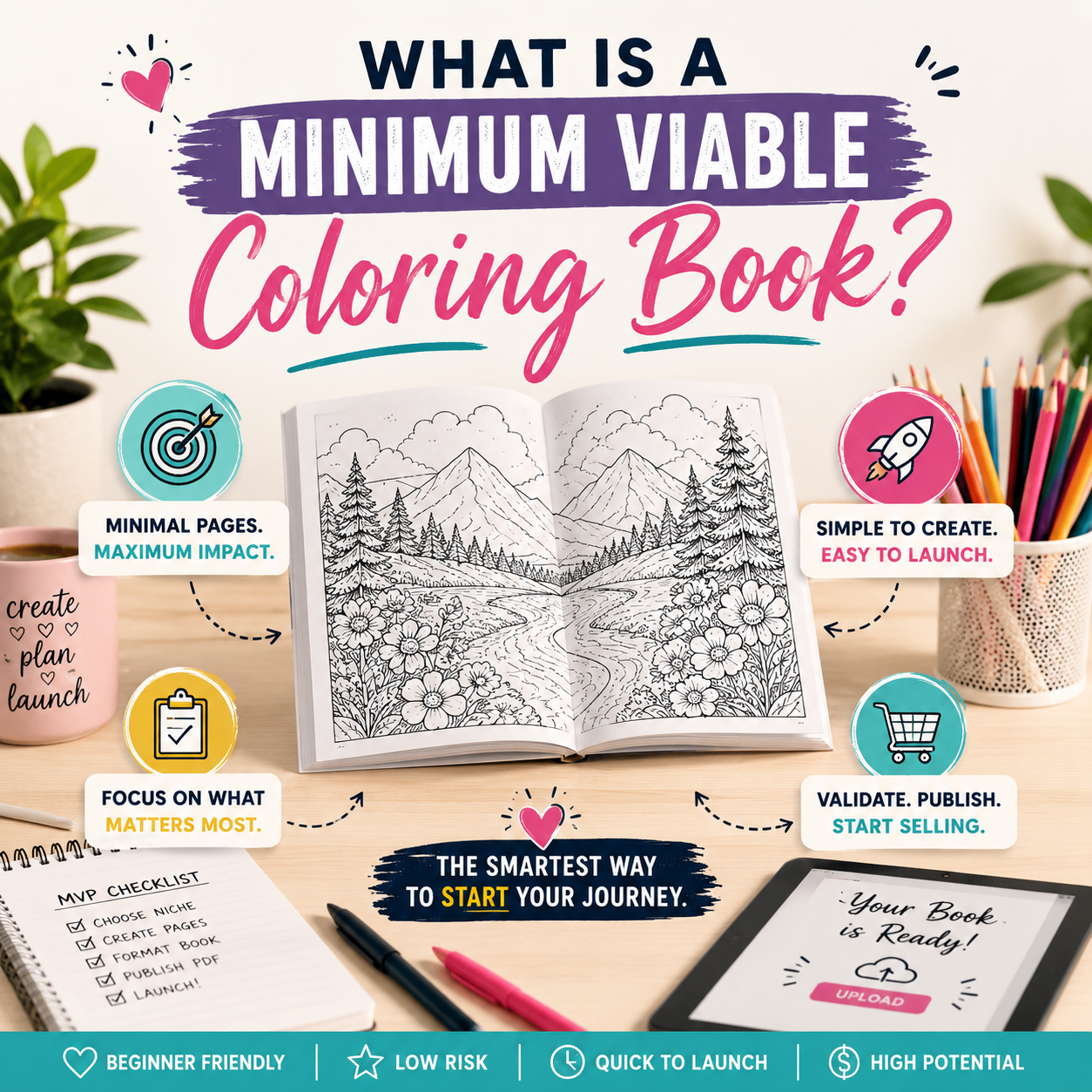
What is a Minimum Viable Coloring Book?
If you’ve ever searched for advice about creating coloring books, you’ve probably seen recommendations like these:
- Create 100 pages.
- Spend weeks perfecting every illustration.
- Design dozens of bonus pages.
- Build an entire product line before launching.
- Wait until everything looks professional.
While those ideas sound reasonable, they often keep new creators from publishing anything at all.
The problem isn’t a lack of talent.
It’s a lack of validation.
A Minimum Viable Coloring Book is built around one simple principle:
Create the smallest complete product that delivers genuine value to a specific audience.
That idea comes from the broader concept of a minimum viable product (MVP), where creators launch a functional product early, gather real feedback, and improve based on actual customer behavior instead of assumptions.
Applied to printable coloring books, the concept becomes surprisingly powerful.
Instead of asking:
“How can I make the biggest coloring book possible?”
you begin asking:
“What’s the smallest coloring book someone would happily pay for?”
That subtle shift changes everything.
Why “Minimum” Doesn’t Mean Low Quality
Some people hear the word minimum and assume it means cheap.
It doesn’t.
A Minimum Viable Coloring Book should still feel polished.
Your line art should be clean.
The pages should print beautifully.
The PDF should be organized.
The cover should look professional.
The customer experience should be excellent.
The only thing you’re minimizing is unnecessary production.
Think of it this way.
Imagine two creators.
Creator A spends six months producing a 120-page coloring book without ever asking whether anyone actually wants it.
Creator B spends one weekend creating a focused 24-page printable for coat lovers, publishes it, gathers customer feedback, and starts earning sales.
Which creator learns faster?
Which creator improves faster?
Which creator reaches product number ten first?
Publishing creates information.
Waiting creates assumptions.
The Hidden Cost of Waiting
Many first-time creators believe more work automatically produces better results.
Unfortunately, that’s rarely true.
Every extra week you spend polishing a product is another week without learning:
- whether your niche resonates
- whether your cover converts
- whether customers understand your listing
- whether your pricing makes sense
- whether buyers actually want another volume
Until a product is available for purchase, every decision is still a guess.
That’s why experienced publishers often release products more frequently than beginners.
They’re no cutting corners.
They’re collecting data.
What Makes a Coloring Book “Complete?”
This is where many beginners become stuck.
A complete coloring book doesn’t need hundreds of pages.
It simply needs to fulfill the promise made on its cover.
If your cover promises:
Cozy Autumn Gnomes
then every page inside should reinforce that promise.
If your title promises:
Cute Kawaii Dogs
every illustration should support that experience.
Completeness isn’t measured by page count.
It’s measured by whether the customer feels they received exactly what they expected.
That distinction matters because trust – not size – is what creates repeat buyers.
The Minimum Viable Coloring Book Mindset
Instead of trying to create your dream product first, think about creating your first successful product.
Successful creators rarely build one giant coloring book.
They build systems.
Each release teaches them something new:
- Which themes attract clicks.
- Which covers convert visitors.
- Which niches produce repeat customers.
- which keywords generate search traffic.
- Which products naturally become bundles.
One small success becomes the foundation for the next.
Over time, those small wins compound into an entire catalog.
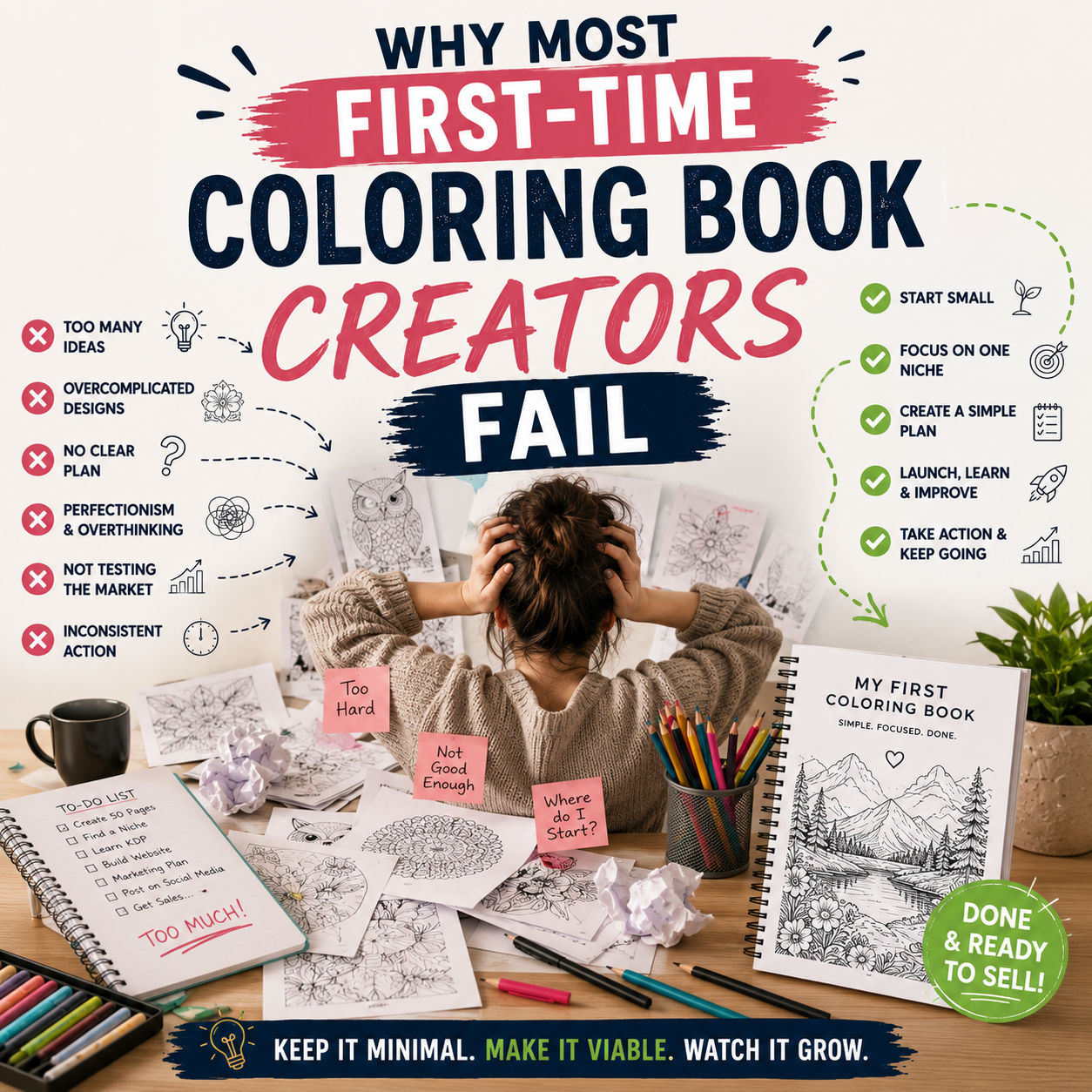
Why Most First – Time Coloring Book Creators Fail
Failure usually doesn’t happen because someone can’t draw.
It happens because they build the wrong product in the wrong order.
Ironically, many beginners work harder than experienced publishers.
They’re simply investing that effort in the least valuable places.
Let’s look at the most common traps.
Trap #1: Building a Masterpiece Before Building a Business
Many creators imagine their first coloring book becoming an instant bestseller.
Because of that expectation, they attempt to create the ultimate product.
They add:
- dozens of bonus pages
- multiple themes
- increasingly detailed illustrations
- complicated layouts
- endless revisions
Months pass.
Nothing gets published.
The problem isn’t ambition.
It’s sequencing.
Businesses grow through iteration.
Masterpieces come later.
Trap #2: Trying to Appeal to Everyone
A coloring book for everyone usually connects deeply with no one.
Compare these two concepts.
Option A
Cute Animals
Option B
Cute Highland Cows Wearing Cozy Sweaters During Autumn
The second immediately create a mental picture.
Specificity increases emotional resonance.
Specificity also makes your product easier for search engines to categorize.
Instead of competing with millions of general coloring books, you’re entering a much smaller search space where buyer intent is stronger.
Trap #3: Confusing Activity with Progress
Creating more pages feels productive.
Adding another illustrations feels productive.
Reworking the cover for the seventh time feels productive.
But none of those activities answer the most important question:
Will someone buy this?
Only publishing can answer that.
Real customers are the only market research that matters.
Trap #4: Waiting Until Everything is Perfect
Perfectionism often disguises itself as professionalism.
Creators tell themselves:
“I just need a few more pages.”
“I’ll launch next month.”
“The cover isn’t quite right.”
“The listing could be better.”
Those improvements may eventually matter.
But they don’t matter as much as gathering your first customer.
The first sale teaches lessons that hundreds of hours of planning never can.
Trap #5: Building Without a Repeatable System
A surprising number of creators approach every new coloring book as though they’re starting from scratch.
They redesign workflows.
They reinvent templates.
They rethink layouts.
They change software.
Eventually, creating one coloring book becomes exhausting.
Successful publishers operate differently.
They create repeatable systems for:
- planning
- illustration generation
- quality control
- page assembly
- exports
- mockups
- product listing
- publishing
- promoton
Each release becomes faster because the process improves – not because the creator works harder.
That shift from isolated projects to repeatable systems is what transforms a hobby into a scalable printable business.
The Bigger Picture
Your first coloring book isn’t supposed to maximize profit.
It’s supposed to maximize learning.
Every sale, every customer question, every download, every review, and every piece of feedback becomes valuable market intelligence.
That’s why the creators who publish consistently often outperform those who spend months perfecting a single product.
Momentum creates experience.
Experience creates confidence.
Confidence creates better products.
And better products create sustainable growth.
Section Takeaway
We’ll build the framework itself by breaking down the ideal Minimum Viable Coloring Book – from page count and niche selection to interior structure, bonus content, licensing pages, and exactly what should (and shouldn’t) be included in your first printable. This is where the concept becomes a practical publishing blueprint.
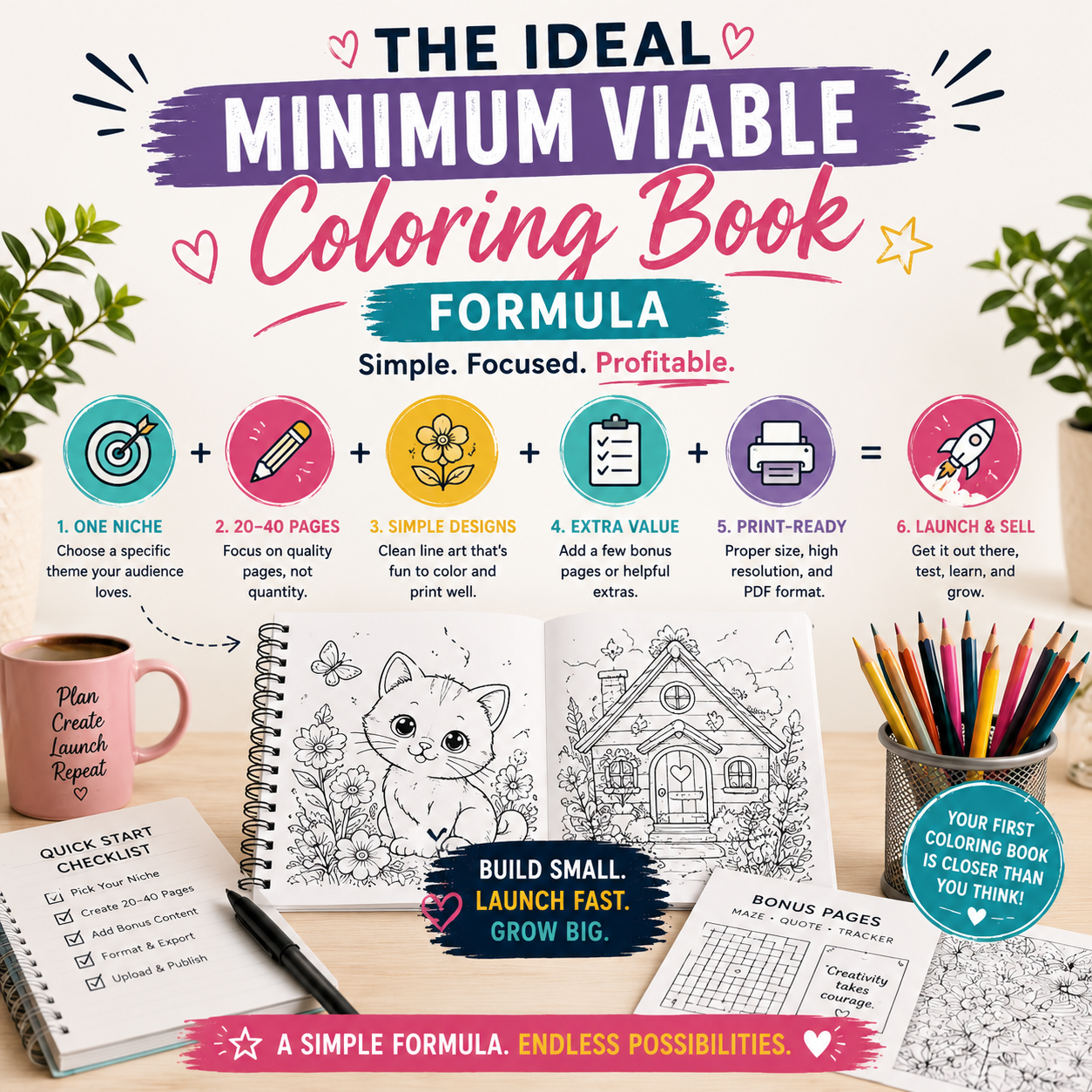
The Ideal Minimum Viable Coloring Book Formula
Once you understand the philosophy behind a Minimum Viable Coloring Book, the next question becomes obvious:
What should actually be inside it?
There isn’t a single magic page count or universal template. A coloring book for young children is built differently than one for adults seeing stress relief, and a printable activity book has different expectations than a paperback published through Amazon KDP.
Even so, successful first products tend to share the same characteristics.
They are focused, complete, easy to understand, and intentionally designed around one clear promise.
The goal isn’t to create the largest coloring book you can imagine.
The goal is to create the smallest product that leaves customers thinking, “I’d happily buy another one from this creator.”
That mindset changes every decision that follows.
Start With One Clear Promise
Every successful coloring book answers one simple question before the customer ever clicks Buy:
“What experience am I paying for?”
Notice that this question isn’t about page count.
It isn’t about artwork complexity.
It isn’t about how long it took to create.
Customers buy outcomes.
Some examples include:
- Relax after a stressful workday.
- Spend quiet time coloring with family.
- Enjoy cozy autumn evening.
- Celebrate Halloween without scary imagery.
- Escape into fantasy worlds.
- Practice mindfulness through creativity.
- Color adorable animals that make you smile.
Everything inside your coloring book should reinforce that single promise.
When every page aligns with the expectation set by your cover and product description, customers experience consistency – and consistency builds trust.
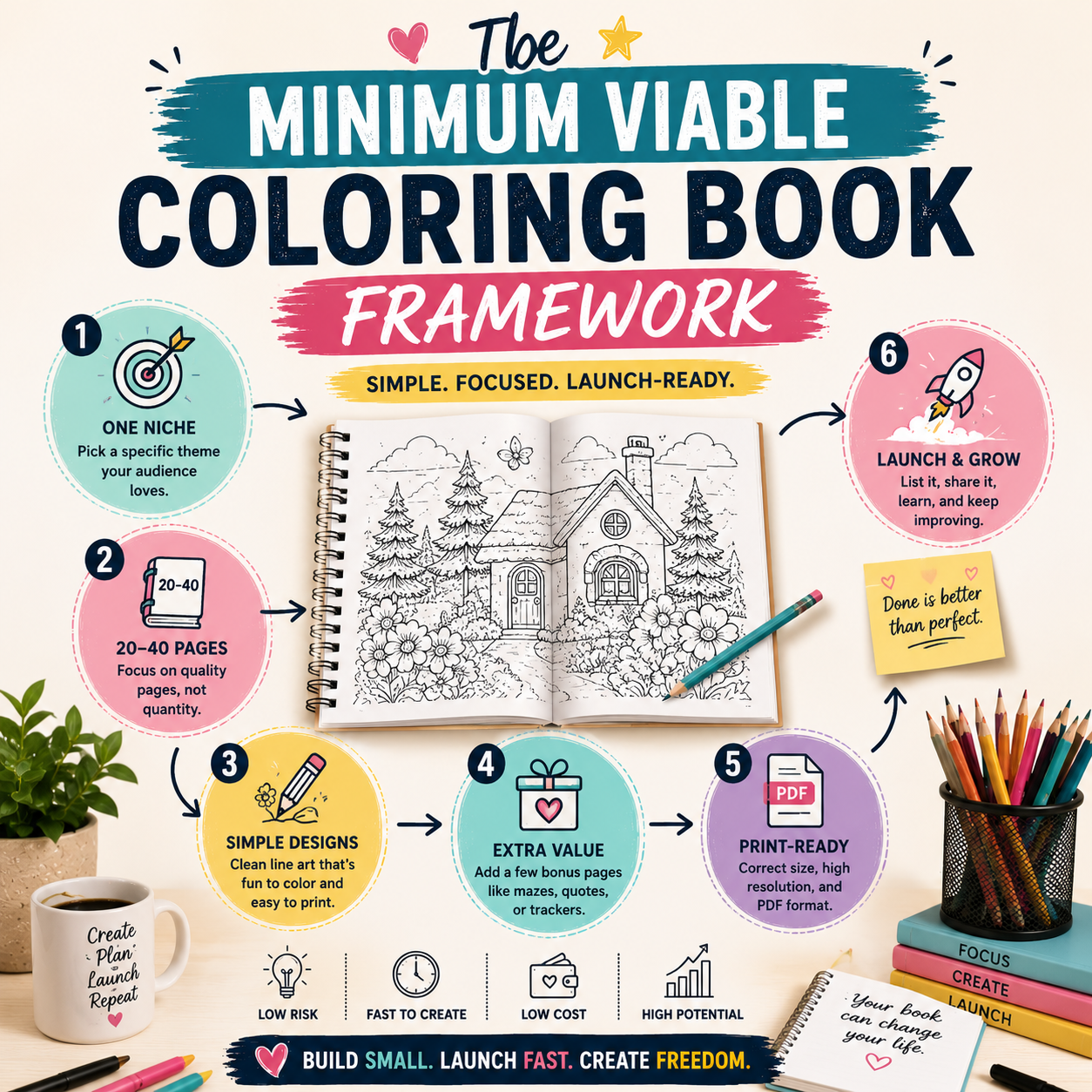
The Minimum Viable Coloring Book Framework
Think of your first printable as a blueprint rather than a one-off project.
Here’s a proven structure that balances customer value with efficient production.
Cover Page
Your cover has one job:
Get the click.
It should immediately communicate:
- Theme
- Audience
- Style
- Emotional outcome
Someone should understand your product within three seconds.
Ask yourself:
- Is the title instantly understandable?
- Does the artwork match the interior?
- Would this stand out as a thumbnail?
- Would someone know who this book is for?
A beautiful cover creates curiosity.
A clear cover creates sales.
You need both.
Title Page
The title page reinforces professionalism.
At minimum, include:
- Product title
- Brand name
- Copyright notcie
Optional additions include:
- Website
- Social media
- QR code
- Collection name
Although simple, this page contributes to the perception of quality.
“This Book Belongs To” Page (Optional)
Especially useful for printable products shared within families, classrooms, or therapy settings.
It also gives the product a more complete, polished feel.
Color Testing Page
One of the most appreciated pages in printable coloring books is also one of the simplest.
A testing page allows customers to:
- Compare colored pencils
- Test alcohol markers
- Experiment with blending
- Check printer settings
This small addition immediately increases practical value.
Core Coloring Pages
This is where many creators overcomplicate things.
Your first coloring book doesn’t need 100 illustrations.
It needs enough high-quality illustrations to satisfy the promise.
A strong range of most printable products is:
- 20 – 40 coloring pages
Why?
Because this provides meaningful value while remaining achievable for a first release.
Each page should feel like it belongs in the same collection.
Maintain consistency in:
- Line weight
- Complexity
- Style
- Theme
- Composition
Avoid random images simply to increase page count.
Customers notice.
Quality Beats Quantity Every Time
Imagine two products.
Product A
- 100 inconsistent pages
- Mixed illustration styles
- Repetitive layouts
- Generic theme
Product B
- 24 beautifully designed pages
- Consistent artistic style
- Strong niche focus
- Memorable customer experience
Which one is more likely to generate positive reviews?
For most buyers, consistency matters more than volume.
Every page should feel intentionally selected – not included because you needed to reach a certain number.
Bonus Pages That Actually Add Value
Bonus content should support the main experience – not distract from it.
Excellent additions include:
Word Searches
Reinforce the theme while extending engagement.
Examples:
- Cozy Autumn
- Fantasy Creatures
- Ocean animals
- Halloween
Mazes
Simple, printable, relaxing.
Perfect for mixed activity books.
Spot the Difference
Adds variety without changing the audience.
Design Your Own Page
Invite creativity.
Examples:
- Design Your Own Dragon
- Create Your Own Cozy Cottage
- Draw Your Own Fairy Garden
These pages increase perceived value while encouraging repeat interaction.
Positive Quotes
Colorable quotes remain extremely popular.
Examples include:
- Progress Over Perfection
- Creativity Begins With One Page
- Small Steps Create Big Dreams
They’re inexpensive to produce while expanding the emotional appeal of the book.
Include Helpful Front and Back Matter
Professional printable products often include several supporting pages that improve the overall customer experience.
Examples Include:
Printing Tips
Help customers understand:
- Best paper weight
- Printer settings
- Single-sided printing
- Marker recommendations
Reducing customer frustration increases satisfaction.
License Page
This is particularly important for digital products.
Cleary explain:
Personal Use
- Print unlimited copies for yourself.
- Print for immediate family.
Commercial Use (if offered)
- Physical resale allowed.
- No digital redistribution.
- No sharing source files.
- No Amazon KDP upload unless explicitly permitted.
Clear licensing reduces confusion while protecting your work.
About the Creator
People increasingly buy from creators – not anonymous stores.
Include a short section explaining:
- Why you create coloring books
- Your mission
- Where customers can find future releases
This helps transform one-time buyers into long-term supporters.
Thank You Page
Never waste the final page.
Instead, guide customers toward the next step.
Examples:
- Visit your website.
- Download a free sample pack.
- Browse additional coloring books.
- Join your email newsletter.
- Follow you on social media.
Every product should help grow your business beyond a single sale.

How Many Pages Should Your First Coloring Book Have?
One of the most common questions new creators ask is:
“What’s the ideal page count?”
The honest answer is:
Enough to fulfill the promise.
Not enough to delay publishing.
For most printable coloring books, this is an excellent starting range:
|
Product Type |
Recommended Length |
|---|---|
|
Mini Coloring Book |
15 – 20 pages |
|
Standard Printable |
20 – 40 pages |
|
Premium Printable Collection |
40 – 60 pages |
|
Large Bundle |
Multiple books combined |
Notice what’s missing.
There is no requirement to begin with 100 pages.
Publishing three focused 24 – page books often creates more opportunities than publishing one oversized project.
Three products can target:
- Three keywords
- Three Pinterest campaigns
- Three blog posts
- Three lead magnets
- Thee customer audiences
Small products multiply your discoverability.
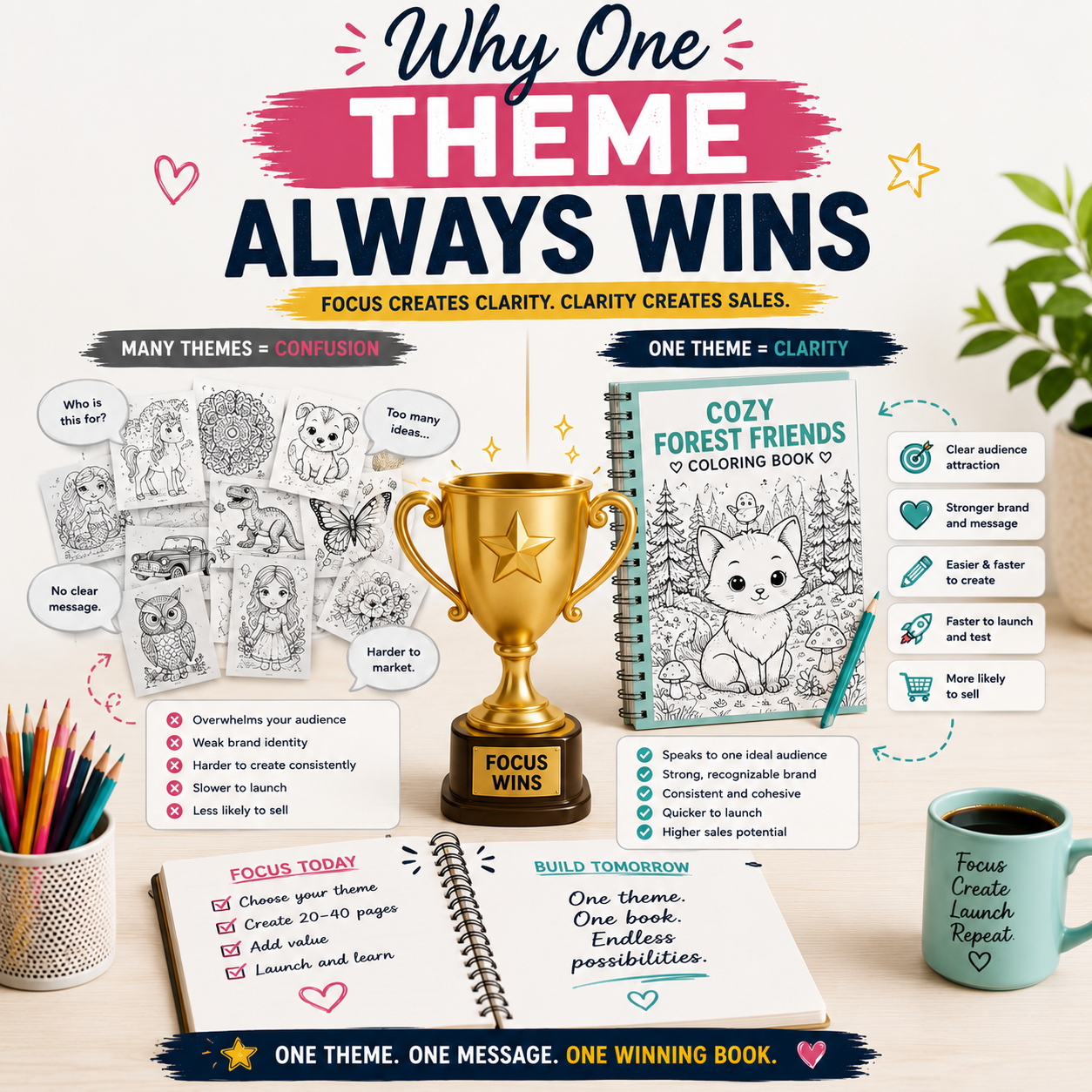
Why One Theme Always Wins
A common beginner mistake is trying to appeal to every coloring enthusiast at once.
The result often looks something like this:
- Cats
- Dragons
- Flowers
- Mandalas
- Cars
- Food
- Halloween
- Unicorns
While there may be excellent illustrations inside, the product lacks a clear identity.
Now Compare that with:
Cozy Autumn Highland Cows
Immediately, the audience understands:
- The mood
- The style
- The season
- The emotional experience
Specific themes make marketing easier because they create stronger associations in both human memory and search engine understanding.
They also open the door to future collections:
- Volume 2
- Christmas Edition
- Spring Edition
- Beginner Edition
- Large Print Edition
One focused niche often becomes an entire product ecosystem.
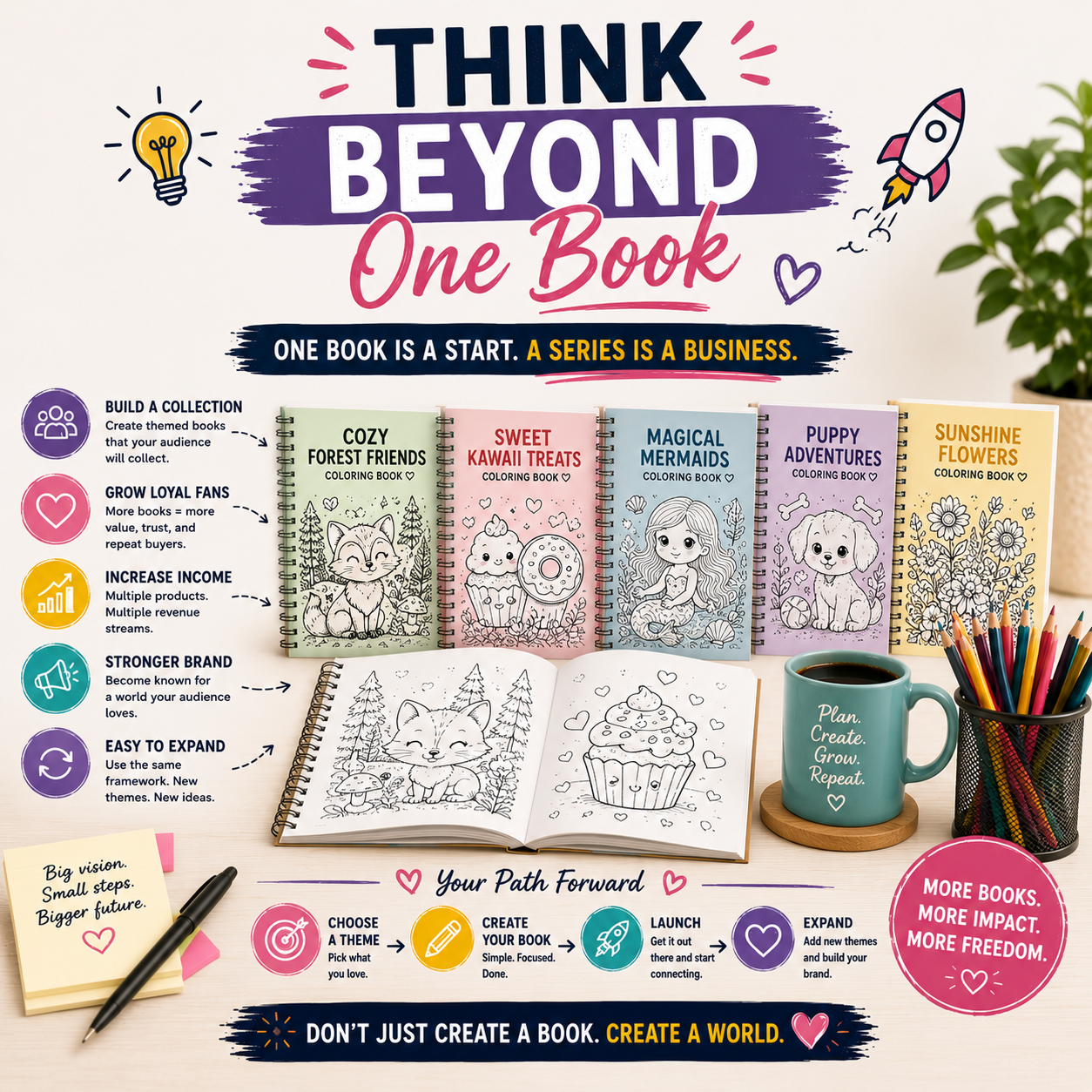
Think Beyond One Book
The biggest shift successful creators make is this:
They stop asking,
“How can I make this coloring book bigger?”
Instead, they ask,
“How can this coloring book become the first book in a series?”
That subtle difference changes your entire publishing strategy.
Rather than exhausting every idea in a single release, you intentionally leave room to expand with companion titles, seasonal variations, themed bundles, activity editions, and collector-style volumes. Each new release reinforces your brand, strengthens your topical authority around a niche, and gives previous customers another reason to return.
A Minimum Viable Coloring Book isn’t the finish line.
It’s the foundation.
It’s the first building block in a catalog designed to grow over time – one focused, high-quality printable at a time.
Section Takeaway
By now, you should have a clear picture of what belongs in a Minimum Viable Coloring Book – and, just as importantly, what doesn’t. The most successful first products aren’t packed with unnecessary pages or unrelated content. They are intentionally focused, professionally presented, and built to validate demand quickly.
In the next section, we’ll move from structure to strategy by showing you how to choose a niche with genuine sales potential, avoid oversaturated markets, and identify themes that can grow into an entire collection of printable coloring books rather than a single standalone product.

Choosing One Niche Instead of Ten
One of the fastest ways to turn a promising coloring book into a forgettable one is to make it about everything.
New creators often believe adding more themes will attract more buyers.
It feels logical.
If one person likes dragons and another likes flowers, why not put both in the same book?
Because customers rarely search that way.
Search engines – and people – reward specificity.
Someone looking for cozy cottage coloring pages isn’t usually hoping to browse dinosaurs, motorcycles, and tropical fish on the next page.
They want exactly what they searched for.
The clearer your niche, the easier it becomes for customers to recognize your product, for search engines to understand it, and for your brand to become associated with that topic.
That’s why choosing one niche isn’t limiting.
It’s positioning.
Why Narrow Niches Often Produce Better Results
Imagine walking into a bookstore.
One book is titled:
Beautiful Coloring Book
The other is titled:
Cozy Autumn Bookshops: 30 Relaxing Coloring Pages for Book Lovers
Which one instantly creates a picture in your mind?
Specificity removes uncertainty.
It tells customers:
“This was made for someone like me.”
That feeling of recognition is powerful.
People don’t simply buy coloring pages.
They buy identities.
They buy moods.
They buy hobbies.
They buy moments.
Your niche should capture one of those emotional experiences.
Think in Communities, Not Categories
Instead of asking,
“What should I draw?”
Ask,
“Who am I creating this for?”
This small change leads to much stronger product ideas.
For example:
Instead of:
- Animals
Think:
- People who adore Highland cows
- Golden Retriever owners
- Birdwatchers
- Horse lovers
- Cat rescue supporters
Instead of:
- Fantasy
Think:
- Cottagecore fans
- Fairy enthusiasts
- Dragon collectors
- Witchy home decor lovers
- Cozy fantasy readers
Instead of:
- Halloween
Think:
- Cute spooky fans
- Cozy horror readers
- Gothic kawaii enthusiasts
- Haunted house decorators
- Pumpkin season lovers
Communities create repeat buyers.
Generic categories create one-time shoppers.

Characteristics of a Strong Coloring Book Niche
Before investing time into a creating illustrations, evaluate your idea using five simple questions.
1. Is There Existing Demand?
Demand doesn’t require millions of searches.
It simply requires proof that people care.
Some indicators include:
- Books already being sold
- Pinterest boards with engagement
- Active Facebook groups
- Popular hashtags
- YouTube tutorials
- Etsy listings
- Blog content
- Reddit discussions
You’re looking for evidence – not guarantees.
If nobody is talking about the subject, you’ll probably spend more time educating customers than selling to them.
2. Can Someone Instantly Understand It?
Imagine explaining your book in one sentence.
If people immediately understand it, you’re moving in the right direction.
Examples:
- Cozy Winter Cabins
- Cute Capybaras
- Botanical Mandalas
- Relaxing Japanese Gardens
- Whimsical Mushroom Houses
Notice how each creates a vivid mental image.
Clarity increases clicks.
3. Can It Become a Series?
This question is often overlooked.
Don’t ask whether you have enough ideas for one book.
Ask whether you have enough ideas for ten.
For example:
Cozy Bookshops
could expand into:
- Cozy Libraries
- Cozy Reading Nooks
- Cozy Coffee Shops
- Cozy Book Cafes
- Cozy Writer Studios
One niche becomes an entire publishing ecosystem.
4. Does It Solve an Emotional Need?
Every successful coloring book delivers an emotional outcome.
Ask yourself:
What feeling does this niche create?
Example include:
Relaxation
- Mandalas
- Nature
- Gardens
- Waterfalls
Comfort
- Cozy cottages
- Warm cafes
- Autumn scenes
Joy
- Kawaii food
- Cute animals
- Happy monsters
Adventure
- Pirates
- Dragons
- Fantasy kingdoms
Nostalgia
- Vintage toys
- Old bookstores
- Classic diners
The illustrations are simply the vehicle.
The emotion is the product.
5. Can Buyers Easily Describe It?
Great products are easy to recommend.
Someone should naturally say:
“You’d love this coloring book. It’s full of adorable ghost cafes.”
If your concept requires a paragraph to explain, it’s probably too broad.
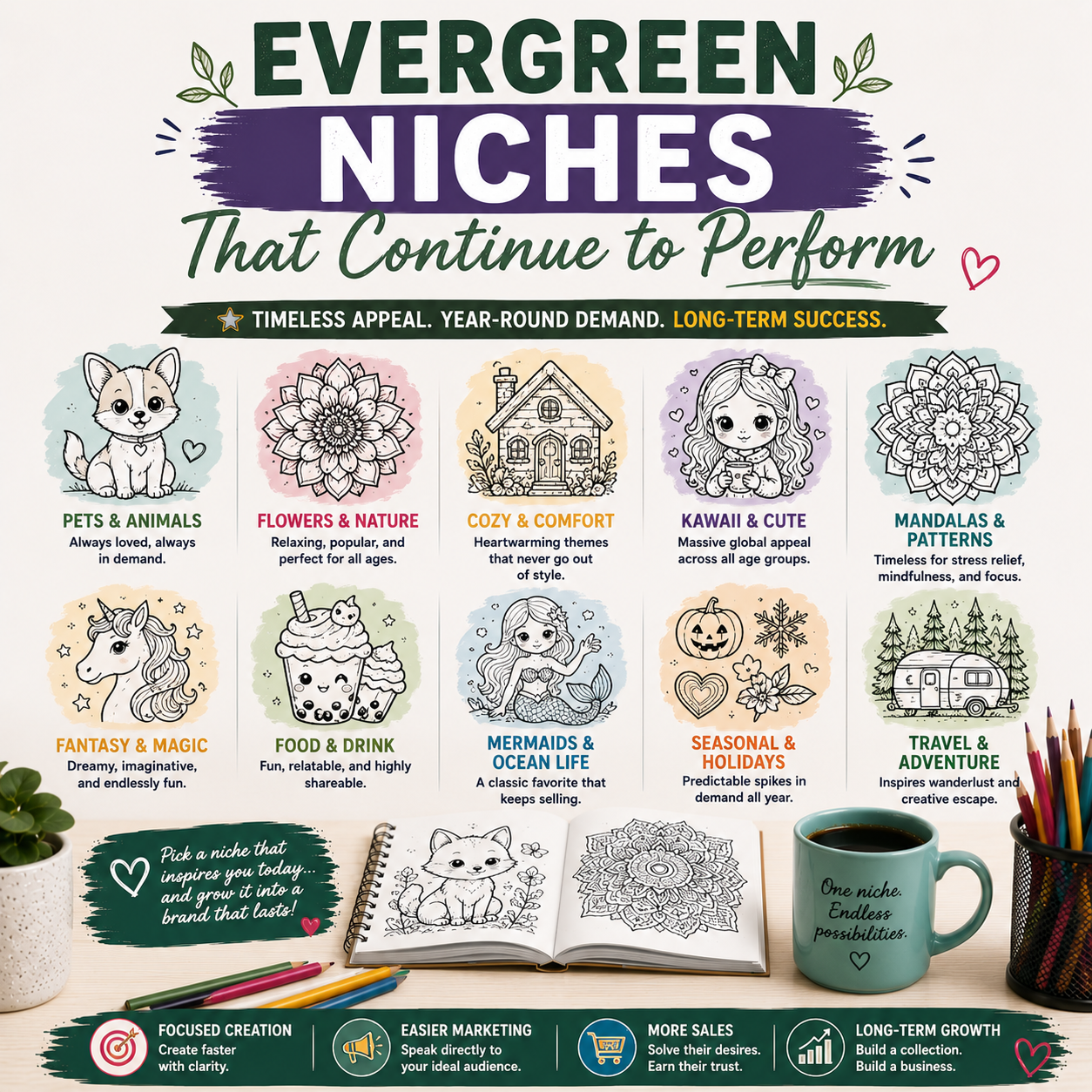
Evergreen Niches That Continue to Perform
while trends come and go, some themes consistently attract buyers year after year.
These include:
Animals
Popular examples:
Animals appeal across nearly every age group and often encourage repeat purchases.
Cozy Living
Growing interest in slower lifestyles has made cozy themes especially popular.
Examples include:
These books appeal to customers looking for calm, comfort, and mindfulness.
Fantasy
Fantasy remains one of the strongest long-term categories.
Ideas include:
Fantasy also supports multiple skill levels and artistic styles.
Seasonal Collections
Seasonal products naturally encourage repeat purchases.
Examples include:
One successful seasonal title can become an annual tradition.
Kawaii
Cute illustration styles continue to attract strong engagement.
Examples:
The niche is especially effective for printable products because of its broad appeal and shareable aesthetic.
Mindfulness and Stress Relief
Many adults purchase coloring books specifically to unwind.
Examples to include:
These themes solve a clear emotional problem.
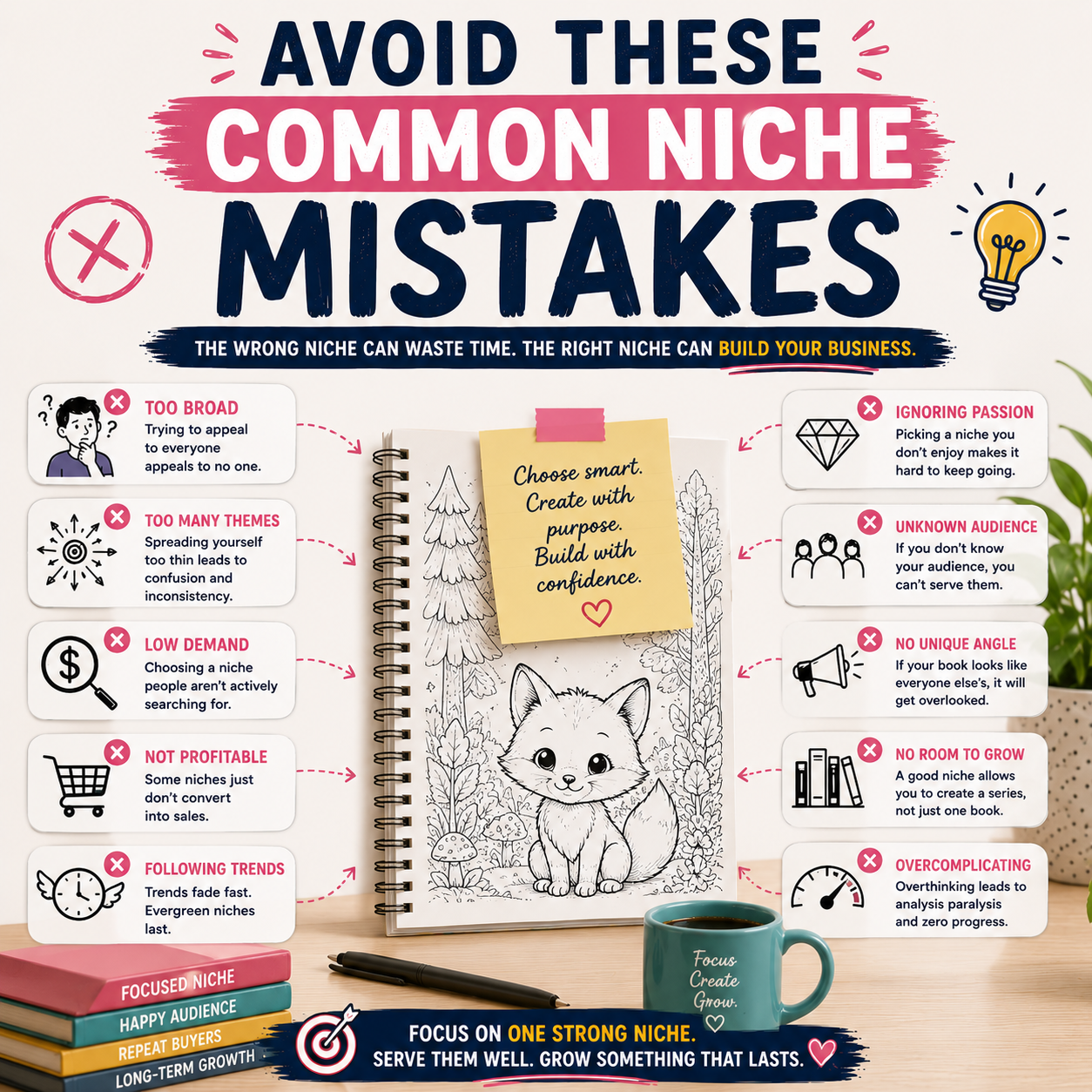
Avoid These Common Niche Mistakes
Not every idea makes a strong first product.
Here are a few pitfalls to avoid.
Mistake: Chasing Every Trend
Trending topics can generate quick attention, but they often disappear just as quickly.
Evergreen niches provide a more stable foundation for building a long-term catalog.
A balanced strategy is to create mostly evergreen products while occasionally publishing timely seasonal or trend-inspired releases.
Mistake: Combining Unrelated Themes
Examples like:
- Dinosaurs + Cupcakes + Space + Farm Animals
make it difficult for both customers and search engines to understand your product.
Focused themes create stronger relevance signals.
Mistake: Ignoring Commercial Potential
Some ideas are fun to create but difficult to market.
Ask yourself:
- Can I imagine someone searching for this?
- Could I build multiple products around it?
- Would I enjoy promoting this niche for years?
Remember, you’re not just creating one coloring book.
You’re choosing a topic that could become part of your brand identity.

Build a Niche Ladder Instead of a Single Product
One of the most effective long-term publishing strategies is what you think of as a Niche Ladder.
Instead of creating unrelated books, build interconnected collections that naturally lead buyers from one product to the next.
For example:
Parent Topic
Cozy Fantasy
↓
Collection
Cozy Dragons
↓
Individual Products
Now imagine writing blog posts for each.
Creating Pinterest graphics.
Publishing social media content.
Building email campaigns.
Creating printable bundles.
Each new product strengthens the authority of every product that came before it.
This is how topical authority compounds – not just for search engines, but in the minds of your audience.

Validate Your Niche Before You Create a Single Page
Here’s one of the biggest advantages of digital products: you can validate demand before investing dozens of hours into production.
Before you start illustrating, ask yourself these questions:
If the answer to most of these questions is “yes,” you’re likely working with a niche that has room to grow.
From Niche to Brand
Your niche isn’t just the subject of your first coloring book. It’s the starting point for an entire body of work.
When customers recognize a consistent style, theme, and experience across your products, they stop shopping for individual coloring books and start looking for your next release.
That’s a significant shift.
You’re no longer competing on a single product. You’re building a recognizable creative brand.
And that’s exactly where a Minimum Viable Coloring Book begins to pay dividends.
Building Your First Book in One Weekend
At this point, you know what a Minimum Viable Coloring Book is, why it works, and how to choose a niche with long-term potential.
The next challenge is execution.
Many creators lose momentum because they don’t have a clear production process. They jump between brainstorming, designing, editing, and marketing without a plan, stretching what could have been a weekend project into several months.
In the next section, we’ll replace that uncertainty with a practical workflow. You’ll learn how to plan, create, assemble, review, and publish your first printable using a streamlined system that prioritizes progress, consistency, and quality – without falling back into the perfectionism trap.
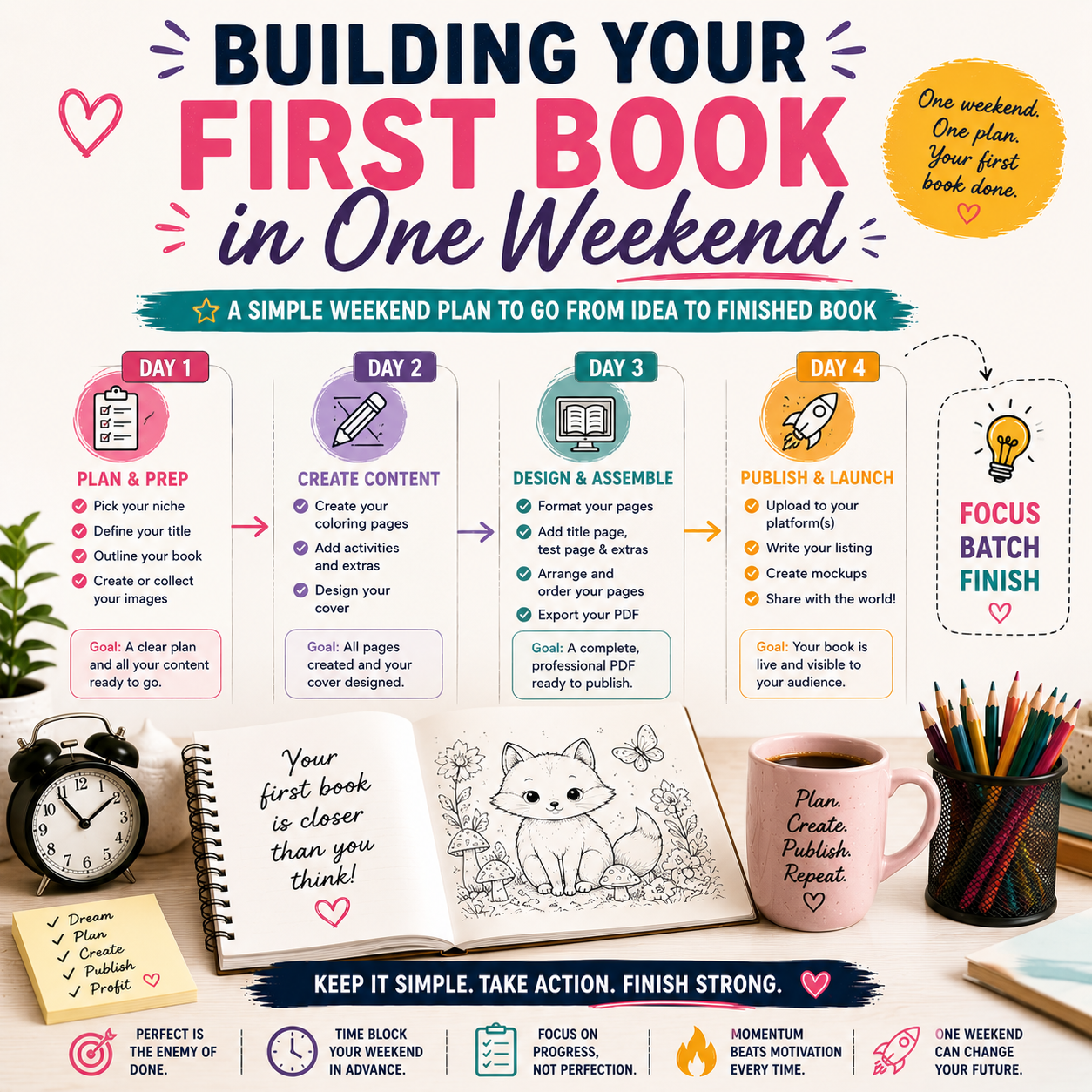
Your First Book in One Weekend
By now, you’ve chosen a niche and understand what belongs inside a Minimum Viable Coloring Book.
Now comes the part that intimidates many first-time creators.
Actually building it.
Fortunately, creating your first printable doesn’t require months of work, expensive software, or a publishing team.
What it does require is a structured workflow.
When every task has a place, decisions become easier. You spend less time wondering what to do next and more time making measurable progress.
Think of this section as your production roadmap.
The exact timeline will vary depending on your experience, but the sequence stays remarkably consistent.
Phase 1: Plan Before You Create
One of the biggest productivity mistakes is opening your design software before you know what you’re building.
Start with a simple planning document.
Answer these questions:
If you can’t answer those questions clearly, don’t begin creating artwork yet.
Clarity saves hours of revisions later.
Create a One-Sentence Product Statement
Every successful product can be summarized in one sentence.
For example:
“A printable coloring book featuring cozy autumn bookshops designed to help adults relax after buys days.”
Or:
“A collection of adorable gothic kawaii girls for adults and teens who love spooky – cute art.”
That sentence becomes your decision filter.
Every illustration should support it.
Every bonus page should reinforce it.
Every marketing asset should communicate it.
If something doesn’t strengthen that promise, it probably doesn’t belong in the book.
Phase 2: Build the Structure First
Resist the urge to start drawing page one immediately.
Instead, create the framework of the entire book.
For example:
Now your project feels manageable.
Instead of staring at a blank canvas, you’re simply filling in predefined sections.
Remember, you’re not just creating one coloring book.
You’re choosing a topic that could become part of your brand identity.
Outline Every Coloring Page
Before creating artwork, list every illustration.
For example:
Cozy Autumn Bookshops
Notice how every idea reinforces the same emotional experience.
Consistency is easier when the roadmap exists before the artwork.
Phase 3: Create Consistently, Not Randomly
Now it’s time to create your illustrations.
Whether you’re drawing by hand, using digital illustration software, or responsibly incorporating AI into your workflow, consistency matters more than novelty.
Maintain:
Customers rarely expect every page to be extraordinary.
They do expect every page to belong in the same collection.
Think Like an Art Director
As you review each illustration, ask:
Would this page look out of place if someone flipped through the book?
If the answer is yes, revise it or replace it.
Your job isn’t simply to create attractive images.
Your job is to curate a cohesive experience.
Professional publishers edit aggressively.
They remove pages that don’t fit.
That discipline often creates stronger products than simply adding more artwork.
Phase 4: Assemble the Book
Once the illustrations are finished, it’s time to build the product.
Arrange the pages intentionally. Avoid placing highly detailed illustrations back-to-back if possible. Mix visual complexity. Alternate busy scenes with simpler compositions.
Create a rhythm that keeps coloring enjoyable. This small detail improves the customer experience far more than most beginners realize.
Design with Printing in Mind
If customers struggle to print the file, the quality of the illustrations becomes irrelevant. Printing experience is part of product quality.
Phase 5: Perform a Quality Review
Never export immediately after finishing. Instead, conduct a systematic review.
Check every page for:
Many disappointing customer reviews begin with mistakes that could have been caught in a five-minute inspection.
Print a Sample Copy
This step is frequently skipped. Don’t skip it. Print your own book. Use the same printer a customer might use. Flip through every page. Actually color several illustrations. Doing this reveals issues you won’t notice on a computer monitor.
Examples include:
Testing your own product demonstrates respect for your customers.
Phase 6: Export the Final Files
A professional printable product usually includes more than one downloadable file.
Common formats include:
The primary customer file.
Maintain high resolution while balancing file size.
Individual PNG Files (Optional)
Useful for customers who prefer printing individual pages.
ZIP Archive
If multiple file formats are included, package them neatly
Use descriptive filenames.
Examples:
Professional organization improves perceived value.
Phase 7: Create Supporting Assets
The coloring book is only part of the product.
Customers also experience:
These assets deserve planning too.
Strong visuals increase click-through rates before customers ever see the interior pages.
Write Your Product Description Last
Many creators write their sales copy before finishing the product.
Reverse that process.
Once the book is complete, you’ll naturally describe it more accurately.
A strong description answers:
Write Your Product Description Last
Focus on helping customers imagine using the product – not simply listing features.
Phase 8: Publish Before You Feel Ready
This may be the hardest step. At some point, improvements become excuses. There will always be:
Eventually, you have to publish. Your first customers will teach you more than another month of editing.
Progress creates confidence.
Publishing creates progress.
Your First Book Is Market Research
This perspective changes everything.
Instead of expecting your first coloring book to generate thousands of sales, think of it as an experiment.
Questions you’re trying to answer include:
Every sale becomes data.
Every download becomes insight.
Every customer review becomes free consulting.
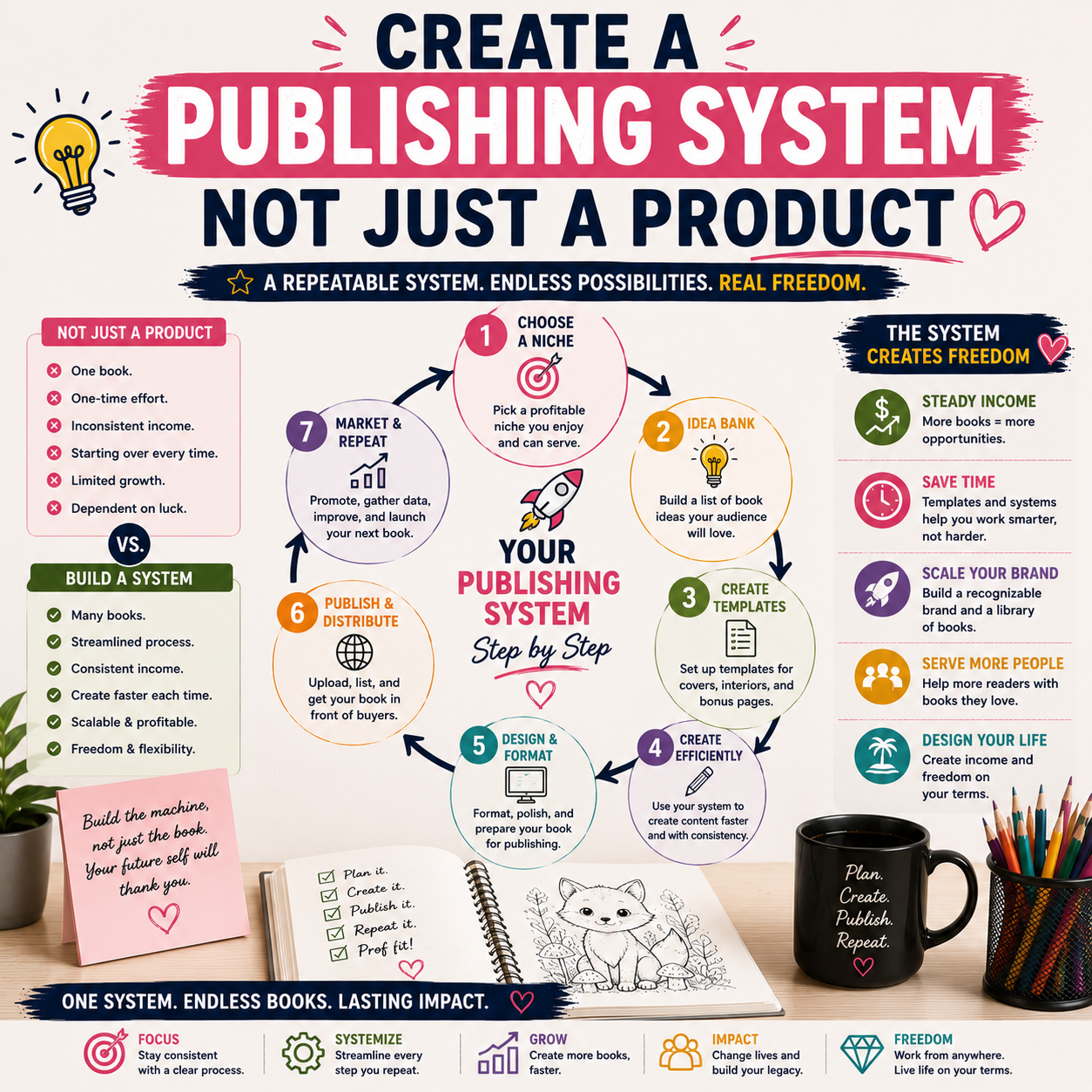
Create a Publishing System, Not Just a Product
Professional creators don’t rely on motivation. They rely on systems.
Document every step you complete:
The first time you build a coloring book, creating these systems takes effort.
The second time becomes easier.
That’s when real momentum begins.
Instead of wondering how to create another product, you’re simply following a proven workflow.
The result is faster production, more consistent quality, and a growing catalog that compounds in value over time.
From Creation to Customers
Finishing your coloring book is a major milestone – but it isn’t the finish line.
A beautifully designed printable can’t generate sales if no one knows it exists.
The next stage is learning where to publish, how to position your product, and how to create multiple opportunities for customers to discover it through search engines, Pinterest, your website, email marketing, and digital marketplaces.
In the next section , we’ll explore where to sell your Minimum Viable Coloring Book, how different platforms fit into a long-term publishing strategy, and why owning your audience is just as important as creating great products.

Where to Sell Your Minimum Viable Coloring Book
Publishing your first coloring book feels like crossing the finish line.
In reality, you’ve just reached the starting line.
A beautifully designed printable only becomes a business asset when people can discover it, trust it, and purchase it easily.
This is where many new creators make another costly mistake.
They spend weeks creating a product, upload it to a single marketplace, and wait.
Sometimes they wait for weeks.
Sometimes for months.
When sales don’t arrive immediately, they assume the product failed.
More often than not, the product wasn’t the problem.
The problem was visibility.
Successful printable businesses don’t depend on one source of traffic.
They build multiple paths that all lead back to the same product.
The Three Pillars of Selling Printables
Your long-term goal should be to build three complementary assets:
Each serves a different purpose, ad together they create a resilient business.
Pillar One: Your Website is Your Digital Headquarters
If you only remember one lesson from this article, let it be this:
Always build a business you own.
Social media platforms change.
Marketplaces adjust their algorithms.
Advertising costs rise.
But your website remains your home base.
When someone visits your website, you control:
Unlike a marketplace listing, every blog post and product page you publish becomes another opportunity to attract organic traffic.
Over time, those pages compound.
A single article written today can continue bringing visitors years from now.
That’s the power of search driven publishing.
Why Content Marketing Matters
Many people think they’re selling coloring books.
They’re actually publishing helpful content that happens to lead to coloring books.
For example, someone searching:
may discover your website long before they discover your products.
Helpful content builds trust.
Trust builds sales.
Search engines reward websites that consistently answer real questions.
The more useful your content becomes, the stronger your topical authority grows.
Turn Every Product Into Multiple Content Assets
One coloring book shouldn’t generate one webpage.
It should generate an entire content ecosystem.
Imagine publishing a printable titled:
Cozy Autumn Bookshops
That single product can become:
Instead of asking, “What should I post today?” you’re simply repurposing the work you’ve already completed.
This approach saves time while reinforcing your expertise across multiple channels.
Pillar Two: Digital Marketplaces Expand Your Reach
Marketplaces offer something your website doesn’t have on day one:
Built-in traffic.
People already visit these platforms looking for printable products.
That makes them valuable, especially for newer creators.
However, marketplaces should complement your business – not become your entire business.
Think of them as discovery engines rather than permanent homes.
Their primary role is to introduce customers to your work.
Whenever possible, encourage those customers to connect with your brand beyond the marketplace through newsletters, blogs, or social media.
That way, you’re gradually reducing dependence on any single platform.
Build for Longevity, Not Convenience
Many creators focus exclusively on short-term sales.
A better question is:
“Where will my customers be two years from now?”
Ideally, they’ll still be connected to your brand.
That’s why every product should gently invite buyers to continue the relationship.
Examples include:
One sale can become dozens when customers know where to find you next.
Pillar Three: Build an Email List From Day One
Traffic comes and goes.
Email remains one of the few marketing channels you truly own.
Someone who joins your email list is raising their hand and saying:
“I’d like to hear from you again.”
That’s valuable.
More valuable than another social media follower. More valuable than another page view. More valuable than another temporary algorithm boost.
Your first email subscriber may eventually purchase:
You’re not just collecting email addresses. You’re building relationships.
Give people a Reason to Subscribe
Simply asking someone to join your newsletter isn’t enough.
Offer immediate value.
Examples include:
The goal isn’t to attract everyone.
It’s to attract people who genuinely enjoy the type of products you create.
Quality subscribers outperform large but disengaged lists.
Turn Every Product Into Multiple Content Assets

Use Search Engines as Your Long-Term Sales Team
One of the biggest advantages of printable products is that they naturally align with search behavior.
People search for solutions.
Your products solve those needs.
For example:
Someone searches:
“Printable cozy coloring pages.”
They find:
A blog article.
That article links to:
A printable coloring book.
The product page invites them to download:
A free sample pack.
The sample pack encourages them to join:
Your email list.
Later, they receive updates about:
New coloring books.
One search becomes an ongoing customer relationship.
That’s significantly more valuable than chasing one-time viral posts.
Create Supporting Content Around Every Product
Instead of thinking only about products, think in terms of topics.
A coloring book should become the center of a content cluster.
Example:
Core Product
Cozy Autumn Bookshops
Supporting articles might include:
Every article strengthens the others.
Every internal link reinforces topical authority.
This is how websites become recognized as subject-matter experts.
Think Beyond One-Time Sales
Every customer interaction should naturally suggest another helpful step.
Someone purchases:
A Halloween coloring book.
Next, they discover:
A Halloween activity book.
Then:
A Christmas coloring collection.
Later:
A seasonal bundle.
Eventually:
A free printable guide leads them back to your website.
Over time, individual purchases evolve into a connected customer journey.
That’s much more sustainable than constantly searching for new buyers.

Build a Product Ecosystem
Rather than creating isolated products, build interconnected collections.
Example:
Cozy Collection
Each product naturally recommends the others.
This increases customer lifetime value while reducing the effort required to earn future sales.
You’re no longer selling individual PDFs.
You’re building a recognizable collection.
Publish Consistently, Not Constantly
Consistency matter more than frequency.
Man creators burn themselves out trying to release products every week.
Instead, focus on maintaining a reliable publishing rhythm you can sustain over time.
That might mean:
Steady publishing builds trust with both your audience and search engines.
Over time, your catalog becomes one of your greatest competitive advantages.
Each new release doesn’t just create another product – it strengthens every product that came before it.
Own the Relationship, Not Just the Transaction
The most valuable sale isn’t your first sale.
It’s the second. And the third. And the tenth. Those repeat purchases rarely happen by accident.
They happen because customers remember your brand, enjoy your products, and have an easy way to hear about what’s coming next.
That’s why your business should be designed to grow beyond individual listings.
Products bring people in. Content builds trust. Email maintains relationships. Your website becomes the hub connecting them all.
Your First Coloring Book is the Beginning, Not the Goal
By now, you’ve probably noticed a common thread running through every section of this guide.
Creating a successful printable coloring book isn’t about producing the biggest product, chasing perfection, or waiting until every detail feels flawless. It’s about building something complete, useful, and focused enough that real people can enjoy it – and then using what you learn to make the next one even better.
That’s the real power of a Minimum Viable Coloring Book.
It gives you permission to stop treating your first project like your life’s work and start treating it like the first step in a much bigger journey. Every decision you’ve made – from choosing a focused niche and creating a cohesive collection of illustrations to building a simple production workflow and deciding where to publish – has been working toward one objective: getting a quality product into the hands of real customers.
Once that happens, something important changes.
You’re no longer guessing what people might like.
You’re learning from actual buyers.
Their purchases, questions, reviews, and feeback become far more valuable than weeks of additional planning. Each release teaches you something new about your audience, strengthens your creative process, and makes the next coloring book easier to produce.
Over time, those improvements begin to compound.
One coloring book becomes a small collection.
That collection grows into a recognizable catalog.
Your catalog builds trust with customers.
And that trust becomes the foundation of a brand that people return to again and again.
Remember, every experienced publisher started exactly where you are now – with an idea and a blank page.
The creators who succeed aren’t necessarily the most talented or the fastest. They’re the ones who consistently finish what hey start, publish thoughtfully, and keep improving with every release.
So don’t wait until your first coloring book feels perfect.
Choose one niche.
Create one complete experience.
Publish it with confidence.
Then let your customers help shape everything that comes next.
Because the most important coloring book you’ll ever create isn’t the one that’s perfect.
It’s the one that finally gets published.
Ready to Build Your Printable Publishing Skills?
Creating your first Minimum Viable Coloring Book is an important milestone – but it’s only the beginning of building a successful printable business. The more you learn about product creation, search engine optimization, marketing, and digital publishing, the easier each new release becomes.
If you’re looking for practical, step-by-step guidance without the hype, explore the growing collection of tutorials here on the Color Me Crazy Club Blog. Every article is designed to help you create better printable products, attract more organic traffic, and build a catalog that grows over time.
Want to follow the journey as new guides, behind-the-scenes workflows, and printable resources are released?
Then Join the Weekly Build Drops by clicking on the button below the FAQs.
Frequently Asked Questions
Join the Weekly Build Drops
At Color Me Crazy Club, I’m documenting the real process of creating printable coloring / activity books, testing ideas, building products, and growing a digital publishing business from the ground up. If you’d like practical tutorials, behind-the-scenes workflows, and new printable resources delivered as they’re released, join Weekly Build Drops and follow the journey as we build a sustainable printable business – one finished coloring / activity book at a time.